
Prong collars have long been a controversial tool in the dog training world. I used them in the past and saw quick results, but over time, I’ve shifted my perspective.
Today, I believe there are more effective, compassionate ways to train a dog that don’t rely on pain or fear. This post explores the pros and cons, why I no longer recommend prong collars, and what I suggest instead.
I used to think walks were non-negotiable. Rain or shine, my dogs had to be walked daily. And if they pulled, we used what we thought worked, including prong collars.

Years ago, when we adopted Bear, he was a 95lb powerhouse with zero leash manners. I remember the stress of trying to walk him with my daughter on her bike and thinking, “How will we ever make this work?”
The prong collar seemed like the answer. It helped me gain quick control, and at the time, I believed it was the most humane option available.
But the more I learned, the more my thinking changed.
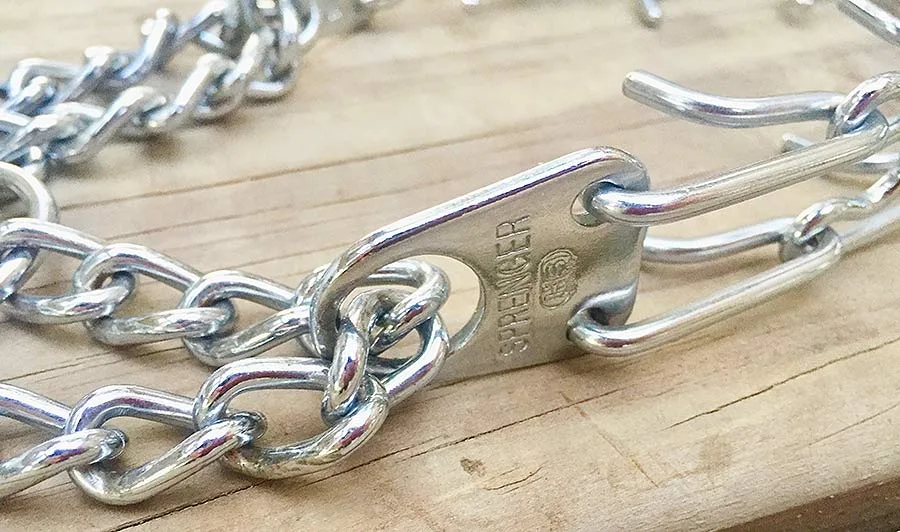
Are Prong Collars Cruel?
This is one of the most frequently asked questions, and the answer isn’t straightforward. Prong collars aren’t inherently cruel… when used properly, they’re designed to apply even pressure around the dog’s neck rather than causing trachea damage like flat collars can. But here’s the catch:
Most people don’t use them properly.
And even when they do, prong collars rely on discomfort to stop unwanted behavior. That’s just not how I want to communicate with my dogs anymore.

Why I Stopped Recommending Prong Collars
Over the years, I’ve fostered dozens of dogs and worked through a wide range of behavioral issues — reactivity, fear, leash pulling, and more. And yes, I used prong collars with some of them in the beginning. I don’t regret those moments; they were part of my learning journey.
However, I’ve also seen how much more powerful it is to build a relationship based on trust, choice, and clear communication, rather than pressure or pain. It might take longer, and it’s not always easy, but the results last longer and feel better for everyone involved.
Instead of reaching for a prong collar these days, I do one of two things:
- I don’t go on a walk right away. I start by sitting in the yard, working on calmness, connection, and attention.
- I use reward-based training and tools like front-clip harnesses or long lines, depending on the dog’s needs.
Walks aren’t the only way to exercise a dog. Mental stimulation, sniff time in the backyard, enrichment games, and play can meet a dog’s needs in a more relaxed, confidence-building way.

Pros and Cons of Prong Collars
Although I no longer recommend them, I think it’s essential to provide a comprehensive picture, especially for those who are desperate for help.
The “Good” (why people use them):
- They can stop pulling quickly
- They’re often used by balanced trainers
- They can be a last resort for strong dogs when other methods haven’t worked
The “Bad and Ugly”:
- They rely on pain or discomfort to stop behavior
- Misuse is common, which can lead to physical and emotional damage
- They don’t teach the dog what to do instead
- They can erode trust between you and your dog

What to Use Instead
There are so many tools and methods that can help you teach your dog to walk nicely on a leash, without fear or pain:
- Front-clip harnesses (we use the Ruffwear Front Range Dog Harness)
- Relationship-based games that teach attention, impulse control, and focus
One of my favorite resources is the Loose Leash Walking online course by SpiritDog Training. It’s a gentle, step-by-step program that teaches your dog how to walk politely without pulling.
➡️ Check out the SpiritDog Loose Leash Walking Course here (affiliate link)
This is a great option if you want expert guidance, especially for dogs who are leash-reactive or overly excited on walks.
And if your dog is struggling with reactivity or fear? Training games that build confidence and help them feel safe are your best path forward.
I cover many of these ideas in my blog and in my Rescue Dog Confidence Training Starter Pack.
Final Thoughts
This isn’t about shaming anyone. I’ve been there. I still see prong collars online or at the park and feel that moment of, “I get why they’re using it.”
But I also know we can do better.
If you’re here because you’re struggling with your dog pulling or being reactive, you’re not alone, and you’re not failing. There are kinder, more effective ways to help your dog, even if they take a little more time.
Want help figuring out where to start? Check out these resources:

My dog like to take off after rabbits . Will that be a problem when he wears the prong collar?
If you use the prong collar correctly and correct your dog BEFORE he takes off for the rabbit, then yes. All dogs will show signals that he is about to lung or go after prey, such as excitement, whining, eye contact, etc. You need to correct the behavior at that point. If you just allow him to pull on the collar and go after the rabbit, it may startle him and if he is sensitive dog, it may correct the behavior. But for a stubborn dog, he may decide the pressure of the prong pulling on his next isn’t enough to not go after the rabbit. If you correct the behavior before he gets into that state of mind, the prong will work.
Am thinking of getting a prong collar for my dog because he recently lunged at a cat he saw and pulled me over. I admit I was not paying full attention to him – was conversing with a neighbor. However, I am afraid of breaking a wrist – or worse; & I have some balance problems. He is only c. 30 lbs., a puggle, but very strong. On walks, sometimes he pulls on leash, other times does not. The pulling can be very tiring – and tiresome. But I don’t want to be cruel, OR injure him. Humane Society, PETA, & SPCA all speak against prong collars. But your points make sense to me.
Hi Dawn, so sorry your pup pulled you over! That is so scary. Many years ago, I had our dog and a foster dog go after another dog when it was icy out and I went flying down on my butt. I did not have prong collars on them, but I am confident if I had, it would never had happened. The prong collar is the opposite of cruel in the right hands. If not used properly, it can be cruel. So make sure to watch the videos in the post about fitting and training. Good luck!
We took our oldest daughter’s Welsh Pembroke Corgi to a trainer. He is a pretty stubborn dog (my understanding is that the breed tends to be that way). He started really being obedient when the trainer put a prong collar on him and she showed him who’s boss with a firm tug or two. He was much better with not pulling for a period of time when I would take him on a walk, but then he went back to his old ways and now pulls like crazy now even with the prong collar. Suggestions?
Are you confident the prong collar is fitted properly? It’s important that the collar is snug around the base of the dogs ears, meaning high up on the neck. If fitting is not the problem, then next review the way you are correcting his pulling, do not pull or nag on the collar, it should always be a quick tug or snap of the collar. If you are consistently pulling the collar he may become numb to any corrections.
I have a ten month old foxhound that I walk daily in the forest for two miles in rugged terrain. I have tried several different collars and leads to stop him from pulling. I want him to walk ahead of me on a 20′-30′ lead along my single file trail. The Halti works great to end the pulling but the lead runs on the ground between his legs so he steps on it. The Thunderleash is clipped on his back so it stays up high where he can’t step on it but he does still pull a bit. It’s better than a choke collar but any pulling gets old on a 2 mile rugged walk. Would a prong collar work on a 20′-30′ lead on a trail? Or must you be on the side of the dog on a short lead? Would the place where the lead clips on end up under the neck and, thus, drag on the ground on a long lead? Thanks!
I’ve never tried a prong collar on anything but a 6′ leash. You wouldn’t have any control at 20+’ The prong is really meant for a quick “snap” of the leash not pulling or nagging on the leash. So I would not recommend the prong in your scenario.
After 3 weeks of work with our 11 month old, highly excitable rescue dog we saw his behavior getting worse and no amount of treats of any kind could get his attention any more. We told our dog trainer all about this today and he introduced us to the prong collar with lots of instruction about how to gently tug the leash with just 2 fingers to get the dogs attention. Results were immediate and wonderful with no signs of distress, only a few sounds of surprise. Our dog seems calmer and more self-controlled and pays more attention than all the treats and tugs and words were able to do. BTW… the trainer only recommended this after understanding the extent of our dog’s A.D.D. personality.
Thanks for your wonderful training resources.
Thank you so much for your story Terry! This is an awesome example of how great of a tool the prong collar can be under the right training. Good luck with your future training of your puppy!
What appealed to me the most in your blog is when you talked about how safe prong collar dogs are because they can’t damage your dog’s trachea given that they are going to be properly used. This is something that I will be sure to remember because I’m planning to buy handmade dog prong collars for my dogs at home. I want to make sure that they won’t get hurt when using the collars that I will buy for them. Thanks for sharing this.
I guess I am one of those 100% pure positive dog trainers and yes their is a more humane way to train the dog. Time, time is all it takes. You noted that you have used these devices for a quick fix when you need foster dogs to walk along side yours… You also made notes about how to introduce the dog to the prong collar, and with the use of reassuring gestures and being patient with the animal, along side the use of treats… why would the prong collar be needed?
I do believe it is each to their own, but to me it is still an aversive tool created for people who do not have time to train their dogs without punishment or the consequence of pain.
Thank you for providing this resource, however nothing would change my mind about it, ever!
For some dogs it is more than just patience. We rescued our pit-lab mix as a puppy and underwent training with him for eight weeks, then again when he was a year old and even had the trainer come to our home to work on specific issues. He has someone home with him 24 hrs a day and has all the love and attention he could want. When we go for a walk he is well behaved- until he isn’t. As a super strong pitty, he can yank a full sized adult over in a half a second to randomly lunge at a person or dog or squirrel. No warning, no rhyme or reason as to when it will occur. If it weren’t for the prong collar, our super sweet 70+lb lapdog would not have been able to stay with us. He responds instantly better when a prong collar is put on him. After 5 years we still must put it on him when in public even though we still do training in private with him frequently to get him to behave on a regular collar. Like I said, he is very well behaved, until he is not. I have never had him so much as attempt to lunge on the prong collar. Sometimes it is NOT the owner, but the dog that needs this collar.
Thank you for telling your story Melanie. I do believe the prong collar has saved many dogs lives. I’m so glad you were able to keep your dog!
Hi Lesa, I appreciate your feedback and the fact you’ve never needed to use a prong is great. But I also believe that most people that are dead against the prong collar never experienced a dog with any severe reactive behavior issues. The prong collar is not punishment or pain. I heard a trainer once describe the prong collar as “power steering” for dog training, which I think is a great analogy. It’s kinda like tapping your dog on the shoulder to keep his attention on you.
I bought a prong collar for my 12-year-old unfixed rescue dog, pitbull. Worked fine for a month then he saw a dog and jerked And the collar broke and went flying and he attacked the dog. Now what should I do? I bought the collar at Petsmart. I’m a 68-year-old skinny woman I don’t have the strength for this dog and don’t know what to do. Had him two years now he has also been attacked by other stray pitbull’s
Hi Carol, the prong collar is known to come apart at the most inconvenient times. Many trainers suggest using a carabiner to connect the prong to the collar. It’s important to check that all links are secure before putting on your dog. I’ve noticed several times that ours become lodged and aren’t connected all the way, leading to it easily being able to break apart when the dog pulls. I highly recommend following a couple of trainers online: https://www.facebook.com/MajorsAcademyDogTraining/ and https://www.facebook.com/SolidK9TrainingRI/ both of these trainers offer a lot of free advice. I would also suggest finding a good behaviorist trainer in your area that can help you one on one.
Carol, good professional dog trainers ALWAYS recommend a back up collar for a prong collar. It is like an airbag, you hope it never has to deploy, but when you need, it better be there!
Also, as the author mention, there are huge differences in the quality of a Pet Smart pinch collar and a Herm Sprenger (the recommended brand)
Can a pinch collar be used on short face dogs such as French Bulldogs,Boston’s or Pugs?
Hi Beverly, Yes you can use a prong collar on a short face dog. Just remember, the collar needs to be high up on the dogs neck, just below the ears. If you find that it’s not working because of the lack of a “neck” try using a slip lead.
I have a 120 lb Great Dane Mastiff mix. He is a rescue who was only 77 lbs when he came to live with me. He eventually started showing extreme aggression towards dogs including my other two rescues. I even sustained a back injury when he took off after a dog on a walk. I was on the verge of having to give him up when I was introduced to the Herm Springer. It literally saved his life. I use to think they were cruel but now I believe they are an invaluable training tool especially for adult rescue dogs with no previous leash training.
Thank you for sharing your story Darci! I am so happy you found a way to change the path of you and your dogs life. There is certainly a lot of misconception around the prong collar, and I feel the only way that will change is when people have a dog like yours and experience how it can be such an invaluable training tool. Thank you for saving a dogs life!