
Prong collars have long been a controversial tool in the dog training world. I used them in the past and saw quick results, but over time, I’ve shifted my perspective.
Today, I believe there are more effective, compassionate ways to train a dog that don’t rely on pain or fear. This post explores the pros and cons, why I no longer recommend prong collars, and what I suggest instead.
I used to think walks were non-negotiable. Rain or shine, my dogs had to be walked daily. And if they pulled, we used what we thought worked, including prong collars.

Years ago, when we adopted Bear, he was a 95lb powerhouse with zero leash manners. I remember the stress of trying to walk him with my daughter on her bike and thinking, “How will we ever make this work?”
The prong collar seemed like the answer. It helped me gain quick control, and at the time, I believed it was the most humane option available.
But the more I learned, the more my thinking changed.
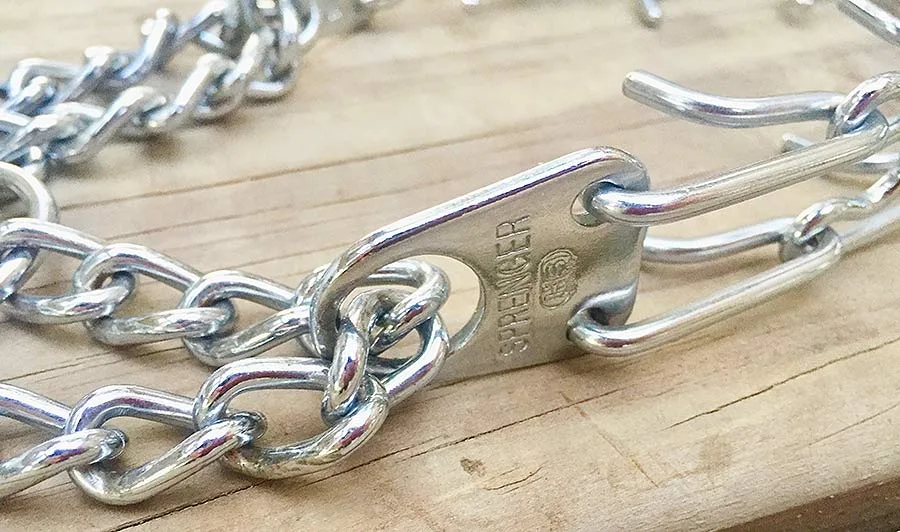
Are Prong Collars Cruel?
This is one of the most frequently asked questions, and the answer isn’t straightforward. Prong collars aren’t inherently cruel… when used properly, they’re designed to apply even pressure around the dog’s neck rather than causing trachea damage like flat collars can. But here’s the catch:
Most people don’t use them properly.
And even when they do, prong collars rely on discomfort to stop unwanted behavior. That’s just not how I want to communicate with my dogs anymore.

Why I Stopped Recommending Prong Collars
Over the years, I’ve fostered dozens of dogs and worked through a wide range of behavioral issues — reactivity, fear, leash pulling, and more. And yes, I used prong collars with some of them in the beginning. I don’t regret those moments; they were part of my learning journey.
However, I’ve also seen how much more powerful it is to build a relationship based on trust, choice, and clear communication, rather than pressure or pain. It might take longer, and it’s not always easy, but the results last longer and feel better for everyone involved.
Instead of reaching for a prong collar these days, I do one of two things:
- I don’t go on a walk right away. I start by sitting in the yard, working on calmness, connection, and attention.
- I use reward-based training and tools like front-clip harnesses or long lines, depending on the dog’s needs.
Walks aren’t the only way to exercise a dog. Mental stimulation, sniff time in the backyard, enrichment games, and play can meet a dog’s needs in a more relaxed, confidence-building way.

Pros and Cons of Prong Collars
Although I no longer recommend them, I think it’s essential to provide a comprehensive picture, especially for those who are desperate for help.
The “Good” (why people use them):
- They can stop pulling quickly
- They’re often used by balanced trainers
- They can be a last resort for strong dogs when other methods haven’t worked
The “Bad and Ugly”:
- They rely on pain or discomfort to stop behavior
- Misuse is common, which can lead to physical and emotional damage
- They don’t teach the dog what to do instead
- They can erode trust between you and your dog

What to Use Instead
There are so many tools and methods that can help you teach your dog to walk nicely on a leash, without fear or pain:
- Front-clip harnesses (we use the Ruffwear Front Range Dog Harness)
- Relationship-based games that teach attention, impulse control, and focus
One of my favorite resources is the Loose Leash Walking online course by SpiritDog Training. It’s a gentle, step-by-step program that teaches your dog how to walk politely without pulling.
➡️ Check out the SpiritDog Loose Leash Walking Course here (affiliate link)
This is a great option if you want expert guidance, especially for dogs who are leash-reactive or overly excited on walks.
And if your dog is struggling with reactivity or fear? Training games that build confidence and help them feel safe are your best path forward.
I cover many of these ideas in my blog and in my Rescue Dog Confidence Training Starter Pack.
Final Thoughts
This isn’t about shaming anyone. I’ve been there. I still see prong collars online or at the park and feel that moment of, “I get why they’re using it.”
But I also know we can do better.
If you’re here because you’re struggling with your dog pulling or being reactive, you’re not alone, and you’re not failing. There are kinder, more effective ways to help your dog, even if they take a little more time.
Want help figuring out where to start? Check out these resources:

My first dog was a female shepherd-mix rescue and I used a prong collar on her to amazing effect. People would comment on how well-mannered she was on walks and after a few years, I didn’t need the prong collar at all.
Fast forward to today. I have a 36-pound mini Australian shepherd who is an epic puller and leash reactive to a ridiculous and, I must say, embarrassing degree. I know that he understands what I want him to do when I tell him to walk close and he does it on occasion, but is too wired and easily distracted — even at three years old — to maintain a loose leash.
When I got him, I vowed to use only positive reinforcement in training, so, rather than use a prong collar again, I tried every other alternative — easy walk, gentle leader, various harnesses and treats. He hates them all — except treats, of course, but they have zero effect on his lunging and pulling.
I finally bought a Herm Sprenger collar and it was moderately helpful. I say moderately, because he still pulled and lunged somewhat.
Then, watching YouTube videos last night, I came across Solid K9 Training (Jeff, above in this blog) and discovered that I was using the prong collar ALL WRONG — even on my first dog. I had it too low on the neck and much too loose.
Now that I understand what I was doing wrong, I have all the confidence in the world that I’ll be able to correct the problem with my mini Aussie and can’t wait to give it a try this afternoon. I am also convinced, after having tried every other “gentle” alternative, that these are a) not effective and b) not kind, because walks with my dog are miserable for us both.
Do not be afraid to try a prong collar. Watch videos, learn how to use the collar correctly ( I wish YouTube had been around when I trained my first dog in 1995!) and know that the collar is the least likely choice of training tools to hurt your dog.
I’ll let you know how our first walk goes!
Suzanne, you are the perfect testimony to how the prong collar can actually change you and your dogs lives. Thank you so much for sharing your story. I am certain it will help others that are struggling.
I rescued a German Sheppard who is roughly a year old Nov of 2018. He already knew all basic commands, house broken and crate trained. However when it comes to walking on a lease he is a puller and aggressive. I have tried regular collars, a harness, e collar now my last resort is a prong collar. I can only hope that the prong collar helps as I am having a hard time controlling him when people and animals walk within eyesight. I want to be able to enjoy walking him not only within the neighborhood but along trails this summer. At this point it’s stressful just trying to walk for basic excerise and needs. Picking up a prong collar tomorrow. Wish us luck!
Good luck! I have a feeling you are going to wonder why it took you so long to try the prong collar. Make sure to check back in, can’t wait to hear your success story.
Thanks for this info. I have a question about prong collar fit- do the prongs need to go all the way around the neck circumference? Is it normal to have a few inches of chain that don’t have the prongs, and does that work as well? Thanks.
There are different styles of the prong collar. I have only used the style that the prongs go all the way around the neck, so I can’t speak of the effectiveness of the ones that don’t. I would think they would still work as long as you have the collar up high on the neck.
I had a guy ask me yesterday, as my dog and I were riding the bus, why I had a prong collar on him. I asked him “why not?” He went on to tell me “they’re known for breaking dogs’ necks”. I laughed out loud and proceeded to tell him how straight front harnesses cause soft tissue injuries to dogs’ shoulders over time. Gentle leaders and the like can cause serious neck injuries like whiplash. Flat collars can cause tracheal damage. Slip leads and choke collars can do the same and cut off air supply. Plain martingale collars don’t provide the same type of pressure to catch a dog’s attention. I have seen all of those injuries in dogs, and I experimented with many of those tools before I tried the prong.
Why did I need to try all those tools? Because I adopted a 90 pound dog that, once he settled in, became seriously dog reactive in a city full of dogs that walk their owners and have no manners. Do you want to know why he was riding the bus with me to work? He’s my service dog now. A couple years of extremely hard work and amazing luck in happening upon a rescue dog with an incredible temperament and work drive, and my goals of having a pet to hike with turned into a lifelong passion for training dogs as a hobby and advocating for responsible dog ownership.
I have since gone on to do board and train with dogs on the side, have taken in numerous problematic foster dogs and trained them for easier placement, and intend to continue doing both so that I can help dog owners and their dogs live calmer, happier lives. I have yet to see a dog injured by normal use of a prong collar (of course I only use Herm as well. And dogs can be abused even without physical contact, so I’m leaving out cases of abuse here). I hope that this informed guy and the other bus passengers who heard what I had to say stop to think about what they’re doing with their dogs and realize that my success is due to learning how to use a prong. Most people won’t dedicate themselves enough and likely don’t have the right dog for this extreme of a transformation, but they can accomplish a lot more if they tried!
Lauren, thank you so much for sharing your story. It is so inspiring, it brought tears to my eyes. And thank you for all you do. Taking in and training foster dogs takes a very special person! You are truly saving lives.
Hello, while I don’t have a prong collar yet (getting one from work soon) I greatly appreciate your article. I thought it was very well written and informative but also not an ‘any other method is terrible’. The kennel I work at is very much 50% training, 50% the tools you use. We have dogs in training classes with prong collars, slip collars, harnesses… everything. I support so much the keep working till you find something that actually works, and make sure you know how to use it before using it. I think that’s what gets so many people especially with e-collars or prong/choke collars, they just get it thinking it will be a quick fix and have no idea how to use it. Keep doing what you are doing 🙂
Yes, Yes, Yes!!! Hannah, Thank you so much for your message. I can’t agree more. There are no quick fixes, and training is not a one time and done type of thing. Training is a life long learning experience, for dogs and humans!
Hi, I have a 90 lb intact lab that I adopted a week ago. He came out of two regular collars so I get a herm sprenger. I see you have recommended a few times to use a carabiner and I don’t know what you mean. Could you post a video or picture of what you are recommending to do?
Thank you
I don’t have one, but found this in a Google search:
Source: precisionk9training.com
When my German Shepherd was very young she had a lot of behavior issues and I was worried she would grow up to become an aggressive dog. I signed up for obedience classes at a well known and reputable training center in our area and they recommended and explained prong collars to us. Once I started using a prong collar on my girl (along with the time commitment of training!), she completely changed. I was stunned how quickly her behavior improved once I started using the prong collar! I had held out at first because I was skeptical, but as I said, once I started using the prong collar it was like night and day!
I still use it, especially on walks and it helps her not pull too hard and injure her neck. It also helps me correct her and keep her focused.
A word of caution though…if you do use one expect criticism from others. I have been lectured by multiple people and even had someone who found my dog once remove the collar and refuse to give it back. Unfortunately, people really just don’t understand these collars and that they can actually help prevent damage or injury, and help owners bond and communicate better with their dogs.
Thank you so much for sharing your story Carole! I love hearing all the success stories.
We just started with a trainer for our 16wk Lab/Shepherd puppy that uses the Herm S prong collar.
Although it is of course immediately effective, I fear he’ll go back to jumping, etc when not wearing it.
:/
(Thank you for posting that video!)
It takes time and a lot of consistency. At first, yes once you take the collar off, he will pull. But with training he will learn. Good luck.
I have a 150lbs St Bernard mix, I can’t walk her she is stronger then me. Will a prong collar help?
Anyone else has used it on large dogs?
Yes it will help you a lot! When we adopted our 95 lb lab, he had no leash manners at all. When used correctly the prong collar will immediately stop your dog from pulling you. Make sure you buy the Herm Sprenger brand I recommend. Not all prong collars are created equal, the cheap versions can have sharp points and break. I recommend using a carabiniere for a back up just in case the links come apart.
Yes. My boy is a saint bernard mix too. Just started using one and he is very easy to walk with one hand.
100% agree if they were hurting the dogs they would be yelping none stop when walking them
Great point. Thanks for sharing.