
Prong collars have long been a controversial tool in the dog training world. I used them in the past and saw quick results, but over time, I’ve shifted my perspective.
Today, I believe there are more effective, compassionate ways to train a dog that don’t rely on pain or fear. This post explores the pros and cons, why I no longer recommend prong collars, and what I suggest instead.
I used to think walks were non-negotiable. Rain or shine, my dogs had to be walked daily. And if they pulled, we used what we thought worked, including prong collars.

Years ago, when we adopted Bear, he was a 95lb powerhouse with zero leash manners. I remember the stress of trying to walk him with my daughter on her bike and thinking, “How will we ever make this work?”
The prong collar seemed like the answer. It helped me gain quick control, and at the time, I believed it was the most humane option available.
But the more I learned, the more my thinking changed.
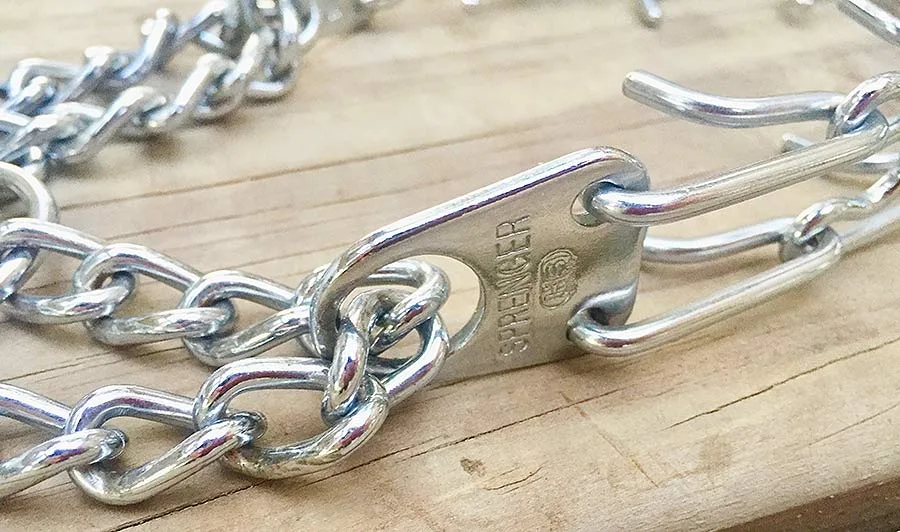
Are Prong Collars Cruel?
This is one of the most frequently asked questions, and the answer isn’t straightforward. Prong collars aren’t inherently cruel… when used properly, they’re designed to apply even pressure around the dog’s neck rather than causing trachea damage like flat collars can. But here’s the catch:
Most people don’t use them properly.
And even when they do, prong collars rely on discomfort to stop unwanted behavior. That’s just not how I want to communicate with my dogs anymore.

Why I Stopped Recommending Prong Collars
Over the years, I’ve fostered dozens of dogs and worked through a wide range of behavioral issues — reactivity, fear, leash pulling, and more. And yes, I used prong collars with some of them in the beginning. I don’t regret those moments; they were part of my learning journey.
However, I’ve also seen how much more powerful it is to build a relationship based on trust, choice, and clear communication, rather than pressure or pain. It might take longer, and it’s not always easy, but the results last longer and feel better for everyone involved.
Instead of reaching for a prong collar these days, I do one of two things:
- I don’t go on a walk right away. I start by sitting in the yard, working on calmness, connection, and attention.
- I use reward-based training and tools like front-clip harnesses or long lines, depending on the dog’s needs.
Walks aren’t the only way to exercise a dog. Mental stimulation, sniff time in the backyard, enrichment games, and play can meet a dog’s needs in a more relaxed, confidence-building way.

Pros and Cons of Prong Collars
Although I no longer recommend them, I think it’s essential to provide a comprehensive picture, especially for those who are desperate for help.
The “Good” (why people use them):
- They can stop pulling quickly
- They’re often used by balanced trainers
- They can be a last resort for strong dogs when other methods haven’t worked
The “Bad and Ugly”:
- They rely on pain or discomfort to stop behavior
- Misuse is common, which can lead to physical and emotional damage
- They don’t teach the dog what to do instead
- They can erode trust between you and your dog

What to Use Instead
There are so many tools and methods that can help you teach your dog to walk nicely on a leash, without fear or pain:
- Front-clip harnesses (we use the Ruffwear Front Range Dog Harness)
- Relationship-based games that teach attention, impulse control, and focus
One of my favorite resources is the Loose Leash Walking online course by SpiritDog Training. It’s a gentle, step-by-step program that teaches your dog how to walk politely without pulling.
➡️ Check out the SpiritDog Loose Leash Walking Course here (affiliate link)
This is a great option if you want expert guidance, especially for dogs who are leash-reactive or overly excited on walks.
And if your dog is struggling with reactivity or fear? Training games that build confidence and help them feel safe are your best path forward.
I cover many of these ideas in my blog and in my Rescue Dog Confidence Training Starter Pack.
Final Thoughts
This isn’t about shaming anyone. I’ve been there. I still see prong collars online or at the park and feel that moment of, “I get why they’re using it.”
But I also know we can do better.
If you’re here because you’re struggling with your dog pulling or being reactive, you’re not alone, and you’re not failing. There are kinder, more effective ways to help your dog, even if they take a little more time.
Want help figuring out where to start? Check out these resources:

With some dogs prong collars are a great tool! Growing up I had a Doberman who couldn’t be walked without it! Now I have an American Foxhound, and while she does pull a little bit at the beginning of a walk she settles right in with her harness pretty quick. It’s all a matter of dog and what the owner is comfortable with! So many people misuse them, but when used correctly they’re very good tools.
Hello,
At what age do you recommend that people start using a prong
Collar? I definitely want to use it. I have a 5 month old
Rottweiler and I need to make sure he does not pull me
In the winters 🙂
I would say no younger than 6 months.
Thank you for this article! We rescued a super sweet lab mix from down south a few months ago. She is a quick learner with all the usual commands and is due to graduate her first round of puppy training classes this Sunday. However, loose leash walking has literally been impossible. We’ve tried all our trainer’s suggestions like carrying a stick shaped treat and letting her have a nibble when she’s at our knee, spatula with cheese/peanut butter, hot dogs, treat sack at our hip and feeding while walking… NOTHING worked. Tried the front clip harness but she would still pull so hard she would flip herself over and on to her side… how does that not break ribs?! Forget a regular collar… she did nothing but choke herself out the entire walk. We felt like failures having practiced with her every single day several times per day with no success. We took different routes, different scenery with woods walks and hikes vs. in the neighborhood… nothing helped. Prong collar was recommended by a co-worker (who received the rec. from his dog trainer) and immediately she ceased the pulling. We put it on in the house about half an hour before taking her for a walk to make sure she was comfortable with it on. She was still her happy-go-lucky self playing. Once we took her out… I was amazed! We’re hoping it’s a temporary training tool only, but I’m still happy to have found this.
I can see how someone would see it as dangerous or harmful. But like you mention, fit is crucial. And don’t be a jerk and pull on it. Give it a light tug if necessary and the unwanted behavior is over. Like others have mentioned, I’m sure the dog is not afraid of this collar if they’re running to you to put it on for a walk. Unlike when our little baby sees her shampoo bottle – she knows it’s bath time and disappears. Funny how that works.
Victoria, you and your pup are a perfect example on how the prong collar is such a life-saver! Thank you so much for sharing your story!
Hi! We rescued a Brittany Mix not long ago and walking with her was miserable! She would pull so hard then entire walk with her two front feet in the air. She wore a harness. Nothing worked until I found this site and started using a prong collar. She was like a different dog! She walked normal and actually we all enjoyed our walk instead of dreading it. It is amazing! I had the stigma that the prong collars were abusive. But I now see how wonderful they are in training my dog. She is so much happier on her walks and so am I. Thank you for sharing this information!!!
Awe Rachel, this is great news! So glad you both can walk together and be happy!
We just rescued a 2 year old (they think) GSD mix this past Tuesday. He came to the pound as a stray but you can tell he has had some training…..he can sit, shake, etc. and has a loving heart. Every once in awhile he will just chill on the kitchen floor by us….but the last day he is all puppy. He has started jumping, and biting and it seems more aggressive. He’s pretty good on walks but pulls to the point of choking himself. My daughter took him out today on a prong collar and she said he did good. My question is I know it can be good for walks but can it also be used in training my dog to stop jumping and biting? I’ve heard that putting a prong collar on an aggressive dog just makes them more aggressive. We plan on taking him to training classes for sure but the dog is making everyone in the family cry, angry, sad because of the jumping/biting. Will the collar help all that?
Positive only trainers will disagree, but no it will not make him more aggressive. The prong could help with the jumping and biting if used correctly. Try keeping him on a leash inside the house for a while. It’s important to understand your pup is still adjusting and pushing the limits. I recommend reading https://www.rescuedogs101.com/bringing-new-dog-home-3-3-3-rule/
I love the prong collar! I have physical disabilities and any pulling from my 62 pound Labradoodle will hurt me. My dog has been going through training to be my service dog and I have been researching weather or not it’s ok to continue using my prong collar with her. I’m not finding anything in the ADA that says anything about these collars ( any collars for that matter). I’ve recently joined a couple of Service Dog sites and everyone on there says that it IS OK to use a prong collar on a trained Service Dog. I have yet to find anything in writing that says this is ok. I need to be able to use my prong collar! I cannot just take the opinions of others because the day WILL COME that I will be challenged by someone out there who tries to bust people for passing their dogs off as service dogs, when indeed, they are not. The prong collar has always been a life-saver for me and my dog!
Hi there, I totally agree with you on prong collars. The bans on them are sad as so many people jump on the band wagon without fully knowing the full story. Shame they don’t research the damage done to dogs by flat buckle ! I follow Jeff Bellman and Skype with him occasionally and love his transparency & honesty about the training tools he uses. I have won over a few of my clients here in Monaco & France re. Use of the prong/e collar & it has changed their lives all for the better & made some very happy dogs too. However they are illegal here so it’s very difficult to promote them in a public way. Humanely training your dog as with children should be a personal choice not one dictated by supposed do gooders and government policies Thanks for your free download I look forward to reading it and sharing! Kind regards. Karen
Hi….i have asweet female bullmastiff…named VODKA…Please guide me when n which sized prong coller fits my VODKA?
You need to measure her neck. The prong collar is adjustable in size by adding/removing links.
Hello,
After doing my research and coming across this website, I’m ready to try a prong collar with my rescue Nala. She’s a 5 year old Great Pyrenees cross that I’ve had the joy of owning for a year now. She’s one of those rescues that really rescue you. Anyways, she had so much leash reactivity when I first adopted her. I didn’t even know what that really was until the first week of taking her for walks. Unfortunately, I think the rescue society I got her from downplayed the leash issues. By the time I realized how bad it was I was so in love with her there was no way I was going to give up on her! So I started on this years path of advice from experienced rescue owners, 1:1 sessions with a personal trainer ( But this got expensive and she made me feel like i was a big part of the problem by not being able to get over my anxieties when we walked by people, dogs etc) I know I have some work to do there and I am trying. But I will never be completely relaxed walking her if shes going to lunge and bark at every person, bike, dog we see on our walks. Which in the summer months of course is everyone we see. I’ve compensated by going out during less busy times and the latest which has been driving to off leash dog parks as she is sooooo much off leash. I’ve also used the gentle leader and it helped somewhat but she walked much slower and really hated it always trying to rub it off her face, which created a whole new set of issues. I can get away with taking her to off leash parks sometimes but I don’t always have the time to drive there as I’m also mom to 3 kids. The pulling she used to have has almost been eliminated by the training techniques my trainer taught us. So now I’m looking to eliminate the lunging at joggers, bikes, people walking towards us with or without dogs and the occasional car that she decides is a threat?? She’ll lunge right onto a road sometimes which is so scary for me. Its a good thing I work out because I can reign her back in but I fear one day she’ll dislocate my shoulder!! The one thing I don’t do is avoid walking her altogether. She needs her exercise and fresh air and i will never deny her of that because of my own fears. But I just wonder if I will ever experience joy in our walks. At this point I don’t care at all what people will think of me if they see a prong collar on her. I know I’d be doing it for everyone’s safety, including theirs, and not as a way to punish my dog. As for the comment about it causing pain, no one has ever mentioned their dog cries out, winces in discomfort. Dogs will definitely be verbal if they are uncomfortable or in pain!! I will post my update soon!
The dog must learn to pay attention and do exactly what you say–for your sake and its. “Ran into the road”? No. This must never happen. It could be killed–along with the child flung into the windshield as her mother hits the brake. It is your responsibility to use the amount of training force necessary to eventually produce instant obedience in public. For my willful, hard-headed, inattentive Doberman yearling, that’s definitely a prong collar for training sessions now. Your timid poodle may never need one. Pay no attention to the idiots who prescribe for your dog without knowing either you or it. Your responsibility is to ensure that your dog responds to essential demands. Right now. Right this instant. You’ll never know whose life you’ve saved.
We rescued a 4 month old 50 lb Anatolian Shepherd/Great Pyrenees mix 5 months ago. He is absolutely gorgeous and has the sweetest disposition. (We are in the process of training him to be a therapy dog to take to local nursing homes/schools etc)He thinks everyone is his friend and wants to play. This made walking him difficult as he wanted to get to anyone or anything he saw. It took everything in me to hold him back and walking him was physically hard on me. We tried positive reinforcement but he is totally indifferent to treats. He likes them, just not enough to be bribed by them. After our trainer introduced us to the prong collar walking with him is a joy. We were very skeptical at first because it does look a bit barbaric. We have been working at it for 5 months now and occasionally I will just use his regular collar….he pulls every time! With his prong collar, I barely even have to hold the leash. When he hears me pick it up he comes running because he knows we’re going out. If it hurt him in any way I seriously doubt he would come running for me to put it on him. He is now 9 months old, over 90 lbs and still growing! We make a concentrated effort to take him as many places as possible and have found some really great dog friendly parks, wineries etc. If it weren’t for this collar we would never be able to do that. The prong collar allows us to share our life with our dog and not just have a dog at home waiting for us to get back from our adventures.