
Prong collars have long been a controversial tool in the dog training world. I used them in the past and saw quick results, but over time, I’ve shifted my perspective.
Today, I believe there are more effective, compassionate ways to train a dog that don’t rely on pain or fear. This post explores the pros and cons, why I no longer recommend prong collars, and what I suggest instead.
I used to think walks were non-negotiable. Rain or shine, my dogs had to be walked daily. And if they pulled, we used what we thought worked, including prong collars.

Years ago, when we adopted Bear, he was a 95lb powerhouse with zero leash manners. I remember the stress of trying to walk him with my daughter on her bike and thinking, “How will we ever make this work?”
The prong collar seemed like the answer. It helped me gain quick control, and at the time, I believed it was the most humane option available.
But the more I learned, the more my thinking changed.
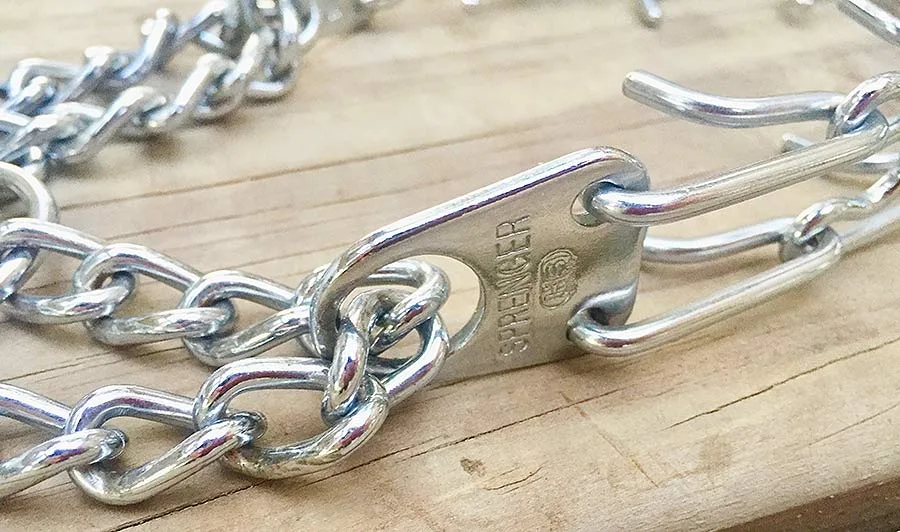
Are Prong Collars Cruel?
This is one of the most frequently asked questions, and the answer isn’t straightforward. Prong collars aren’t inherently cruel… when used properly, they’re designed to apply even pressure around the dog’s neck rather than causing trachea damage like flat collars can. But here’s the catch:
Most people don’t use them properly.
And even when they do, prong collars rely on discomfort to stop unwanted behavior. That’s just not how I want to communicate with my dogs anymore.

Why I Stopped Recommending Prong Collars
Over the years, I’ve fostered dozens of dogs and worked through a wide range of behavioral issues — reactivity, fear, leash pulling, and more. And yes, I used prong collars with some of them in the beginning. I don’t regret those moments; they were part of my learning journey.
However, I’ve also seen how much more powerful it is to build a relationship based on trust, choice, and clear communication, rather than pressure or pain. It might take longer, and it’s not always easy, but the results last longer and feel better for everyone involved.
Instead of reaching for a prong collar these days, I do one of two things:
- I don’t go on a walk right away. I start by sitting in the yard, working on calmness, connection, and attention.
- I use reward-based training and tools like front-clip harnesses or long lines, depending on the dog’s needs.
Walks aren’t the only way to exercise a dog. Mental stimulation, sniff time in the backyard, enrichment games, and play can meet a dog’s needs in a more relaxed, confidence-building way.

Pros and Cons of Prong Collars
Although I no longer recommend them, I think it’s essential to provide a comprehensive picture, especially for those who are desperate for help.
The “Good” (why people use them):
- They can stop pulling quickly
- They’re often used by balanced trainers
- They can be a last resort for strong dogs when other methods haven’t worked
The “Bad and Ugly”:
- They rely on pain or discomfort to stop behavior
- Misuse is common, which can lead to physical and emotional damage
- They don’t teach the dog what to do instead
- They can erode trust between you and your dog

What to Use Instead
There are so many tools and methods that can help you teach your dog to walk nicely on a leash, without fear or pain:
- Front-clip harnesses (we use the Ruffwear Front Range Dog Harness)
- Relationship-based games that teach attention, impulse control, and focus
One of my favorite resources is the Loose Leash Walking online course by SpiritDog Training. It’s a gentle, step-by-step program that teaches your dog how to walk politely without pulling.
➡️ Check out the SpiritDog Loose Leash Walking Course here (affiliate link)
This is a great option if you want expert guidance, especially for dogs who are leash-reactive or overly excited on walks.
And if your dog is struggling with reactivity or fear? Training games that build confidence and help them feel safe are your best path forward.
I cover many of these ideas in my blog and in my Rescue Dog Confidence Training Starter Pack.
Final Thoughts
This isn’t about shaming anyone. I’ve been there. I still see prong collars online or at the park and feel that moment of, “I get why they’re using it.”
But I also know we can do better.
If you’re here because you’re struggling with your dog pulling or being reactive, you’re not alone, and you’re not failing. There are kinder, more effective ways to help your dog, even if they take a little more time.
Want help figuring out where to start? Check out these resources:

Once your dog proper leash etiquette with the prong collar do you have to use it from here on out? Meaning, they are walking well with no correction needed.
The prong collar is a tool to train leash manners. So no, in theory it should not need to be used for ever.
Does the prong collar hinder your relationship with your dog? I don’t want my dog to fear me or become aggressive towards other people or dogs…. also, does she always have to use the prong collar? Or can eventually she go off it and into her normal collar/ no leash? I don’t want her to listen to me just because she fears what comes if she doesn’t. I want her to learn the actual commands I give her.
Have you read the other comments here? The prong collar is not meant to instill fear. The dog will be much happier in fact. My dogs get excited when they see the prong collars come out, it means they are going for a walk and can’t wait to get the collar on! Eventually you can stop using the collar, once she understands pulling is not acceptable. But that isn’t going to happen in just a few days. It could take months or years, depending on your training.
Thanks for the information. I have a 48 lb Whoodle who would wear the gentle harness on our walks in our old location (CT) where we’d go 3-4 miles on a weekend and was great exercise for both of us. We recently moved to a suburb of Boston where walks are now exercise but also to do her business. Gentle Leader no longer works and just bought a front hitch harness which also does not work. I’ve heard about this collar from a Whoodle group I’m in but am concerned that I won’t use it properly and will hurt her. Your comments are spot on that trainers are obsessively against this collar so fear there will be no where for me to go to get training if I were to purchase. Thoughts?
A few thoughts… first, you need to not care what other people think. I know that’s easier said than done. Two, Find a trainer that will work with you and the prong collar. I’ve seen collar covers that disguise the prong. I have not used one so can’t recommend anything specific, but you can find them on Amazon: https://amzn.to/32rG40v
Hi I’m 19 and have a 4 month old Great Dane and he is almost 70Ib I started him out in obedience puppy classes and the trainer there recommend to get a harness but he grew out of it so quickly that wasn’t able to train much with him but even with the harness he was very difficult to walk because he pulls so hard and he chews on his leash like he wants to walk himself. We are switching over to a 1 on 1 trainer very soon hoping it will help with his other problems we are having at home. But do you suggest a prong collar for my Great Dane? I wanted to get one for him when we first started having problems with him but my dad seemed so against it so I decided on not getting one. I know you said you have to be careful with how hard they pull with the prong collar I’m just worried my dog pulls too hard and may injure himself because my dad even has a hard time walking him.
4 months old is border line too young in my opinion. Not that it won’t work, but because he is still young enough to teach him not to pull without it. Do not walk or move while he is pulling and turn around in the opposition direction are two ways to stop the pulling even with a standard collar. If you do try the prong collar, make sure it’s high up on his neck, just below his ears. Watch the video on proper fitting and you will be fine.
I have a year old Great Dane mix. He is a happy go lucky great dog. I walk him 4-6 miles a day, am in obedience & he generally does really well. However he is 120 lbs and I am 62 and 140 lbs. I have tried 2 different harnesses and if he gets really excited he can escape both….once after a groundhog, once when a farm combine crossed in front of us …he escaped the harness only 4 times total in a year, but each time was dangerous. Additionally he pulled my husband to the ground one time. Again 99.9% of the time he is a joy to walk & im walking him and my other dog which could greatly overpower me. I somewhat reluctantly use the prong collar because I know I have control regardless of situation & can keep him safe. Actually he has never gagged, choked or shown any discomfort to prong where I’ve had dogs gag if they pulled hard with flat collar.
I trained my German Shepard/Siberian Husky mix using a pinch collar, got tips on training from a gal who trained duck hunting dogs, she taught me hand signals and all. I used it as you explained back in 1999, maybe for 3 months and periodically as needed over a years time. I had an amazingly trained companion who was really an “off the leash” dog (always carried a leash), used mostly hand signal commands. She was a once in a lifetime soulmate of a dog. She was especially dialed in when hiking in Alaska, saved me from crossing paths with many bears, moose, & wolverines. Lately, I am getting hounded on social media about responding to a post saying it was a great tool for training. Immediately I’m an “abuser”, bla bla bla. Truth is she was the best dog I could have ever had the privilege of rescuing. She lived to be 17 yrs and 4 months, still hiked up until the last 4 months of her life. So yes, I agree, if used properly no issues, in the grand picture it gave her ultimate freedom in living her best dog life.
We just got a new 5 month old Australian shepherd last week. She is very sweet but it’s obvious now that she hasn’t been socialized at all. She is slowly getting used to our house and noises but has a very difficult time with walks (she’s afraid of everything – car, people, loud sounds). We are taking it really, really slowly and not forcing her to go anywhere for the walk – as far as she is comfortable and I try to avoid triggers – but it’s still stressful for her and I want her to feel more confident. I was going to buy a front clip harness (for more control as she is either following her nose without listening to me or tries to run away from scary” things) but after reading your article I’m wondering if a prong collar would be better?. What are your thoughts? I just want her to be happy and enjoy the world!
Patty, it’s worth a try. I’m not a fan of harnesses, as they provoke pulling. The prong is simply a tool as if to “tap” the dogs shoulder to get her attention. BUT she does need help with socialization. She may also just be going through a fear period. It’s very common for puppies to go through several fear periods throughout the 2-9 months of life. You are doing everything right, just take it slow.
Can you use the pinch collar on a 26lb puppy?
Technically yes. But more importantly is the age of the puppy. I personally would not recommend using a prong on a puppy younger than 5 or 6 months old.
I have a 2 year old, big strong 50kg male rottweiler who my ex was supposed to have trained, but only really had him off the lead, Sam doesn’t listen to a word I say when we’re out walking and literally drags me, causing me injury. I have just had a 1 to 1 training session with a trainer and when he first suggested the prong collar I said NO straight away, but I put the collar around my thigh to see the effect. The trainer showed me how to use it properly and within 10 mins, Sam was walking by my side, not pulling and not jumping up at the 2 trainers I had with me, the difference was remarkable!! I had to give him a couple of sharp tugs but after that he soon got the message that if he pulled I would tug him back … My views of these “evil looking” collars has changed and I had got to the stage of not taking Sam out for daily walks as I was scared of being injured myself or him injuring or frightening other people. The dangerous dogs act suggests that an individual only needs to be frightened. Sam has a lovely temperament and not an aggressive bone in his body, he’s just over friendly and too big to be jumping up at people because of the risk of injury. I love him to bits and am looking forward to enjoying our walks from now on.
What a great testament to what a life changing training tool the prong collar can be. I bet Sam is looking forward to enjoying his walks with you just as much as you are!
I’ve used regular collars, choke collars, gentle leaders, harnesses and the prong collar. The prong is the best, the dogs pull much less, even with other dogs, cats and squirrels to distract them. They out weigh me, so it’s important to have them under control. No more choking off the trachea. No more shoulder injuries for me. The dogs hear the rattle of the prong collar and get so excited for their walks! There is no negative association for the dogs, and we’ve even been lucky and not have any people give us looks or comments on their collars either.
I have used every kind of collar for the pups I’ve fostered and adopted. The biggest pup I fostered (who was also a tripaw) did really well with a prong collar but when it was first recommended to me I didn’t want to try it. He was a bully breed mutt and 100 +lbs. I didn’t outweigh him by much. My friend who also trains dogs showed me how to use it properly and it changed our lives! There was never so much as an indent in his skin and I was able to easily control him for the first time. He was also extremely leash reactive and aggressive towards other dogs in general. I wouldn’t recommend trying one without researching how to properly use it but it works really well for some pups. Thanks for sharing this article.