
The 3-3-3 Rule helps adopters understand the timeline for a rescue dog’s adjustment: 3 days to decompress, 3 weeks to learn routines, and 3 months to feel fully at home.
This guide explains each stage, shares real-life stories, and offers tips to help you avoid common mistakes.
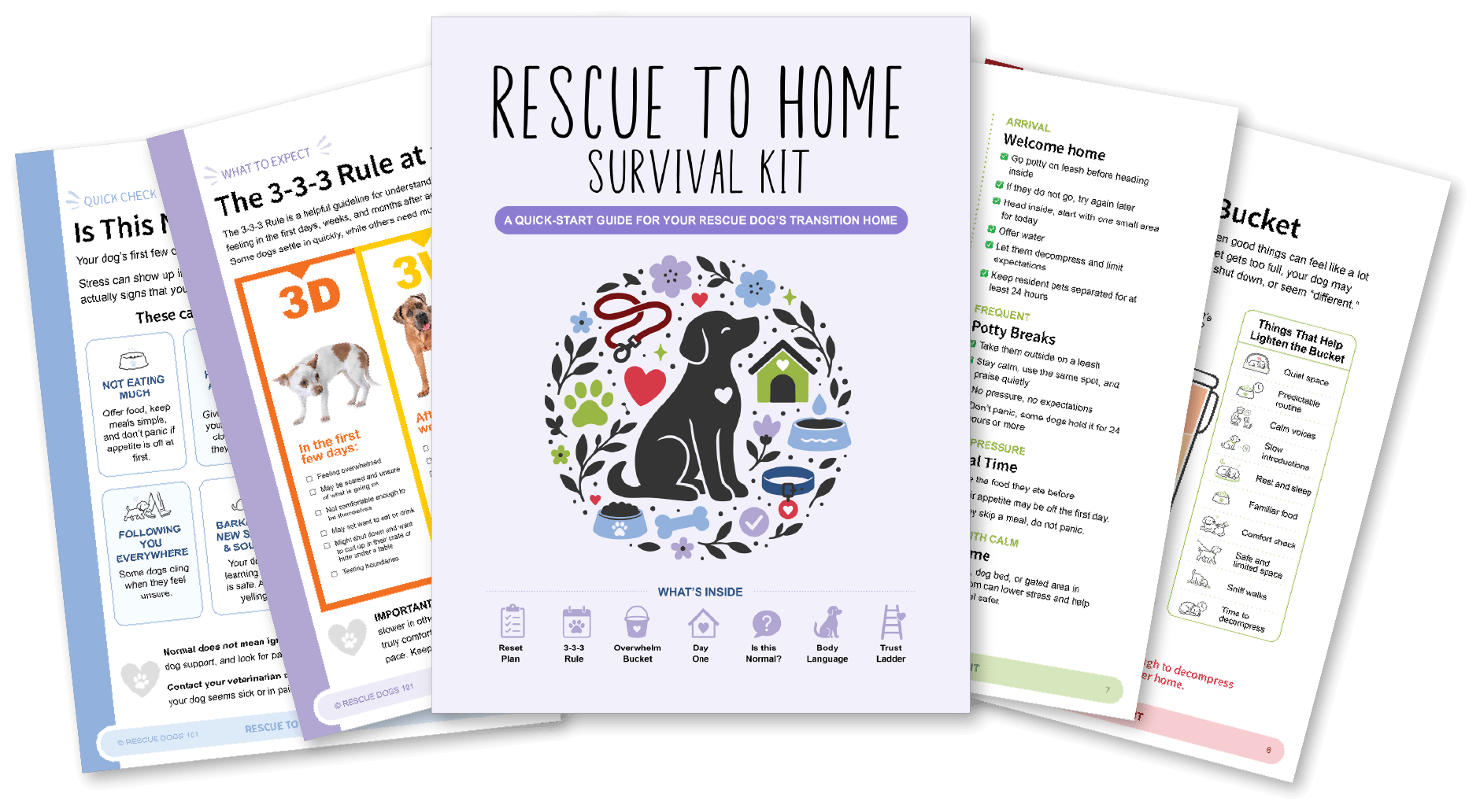
Download my free From Rescue to Home: Survival Kit for step-by-step help.
Or if you’re a rescue/shelter, grab the 3-3-3 graphics and adoption handbook templates for your organization.
What is the 3-3-3 Rule for Dogs?
The 3-3-3 rule is a general guideline that represents the phases of a rescue dog or common milestones your new dog will go through… it is the first 3 days, 3 weeks, and 3 months after bringing your dog home from the shelter.
The 3-3-3 rule is sometimes referred to as the “rescue dog honeymoon period.”
If you’ve ever started a new job or moved to a new school, you know the feeling of being in an unfamiliar place, new surroundings, new people, and new rules. This is how your dog feels as they adjust to their new home.

The 3 Stages of the 3-3-3 Rule
Please note that this is a guideline. The time your dog needs to adjust is as unique as they are.
Here’s what those first 3 days, 3 weeks, and 3 months look like in real life…

3 Days: Decompression
Your dog is likely overwhelmed, nervous, and unsure. Don’t expect too much right away. They might not eat or drink much and could be scared or unsure about their new environment.
Due to the stress, potty accidents may occur. During this time, they might hide or be very cautious around you and your family. Alternatively, they might test boundaries to see what they can get away with, similar to a teenager.
- Feeling overwhelmed
- Maybe scared and unsure of what is going on
- Not comfortable enough to be “themself”
- May not want to eat or drink
- Shut down and wants to curl up in his crate or hide under a table
- Testing the boundaries

3 Weeks: Learning the Routine
By now, your dog will typically start to settle in, feeling a little more comfortable and beginning to understand their new routine. They may start to show their true personality and begin to trust you more.
- Starting to settle in
- Feeling more comfortable
- Realizing this could possibly be their forever home
- Figured out their environment
- Getting into a routine
- Let their guard down and may start showing their true personality
- Behavior issues may start showing up

3 Months: Feeling at Home
This is when transformation shines. Your dog may start to trust you and feel secure in their new home. They may begin to settle into a routine and become comfortable with their environment.
This period is when you will see your dog’s true personality and begin to build a deeper bond.
- Finally, completely comfortable in his home.
- Building trust and a true bond
- Gained a complete sense of security with his new family
- Set in a routine
Adjusting to the Timeline
Remember, these timelines are general guidelines. Every dog is unique, and some may take longer to adjust. It’s important to be patient and not rush the process.
If your dog takes 6, 8, or even 12 months to fully adjust, that’s completely normal. The key is to provide a consistent, loving environment and celebrate the small victories along the way.
Your understanding and support during these phases are crucial in helping your rescue dog feel at home and begin to thrive.
Enjoy your newly adopted dog, give them love, support, and time, and they will soon become your best friend!
Common Mistakes Adopters Make
- Expecting their dog to be “normal” instantly.
- Flooding them with too many new people, places, or dogs.
- Initially, letting rules slide, then trying to enforce them later.
- Ignoring subtle stress signals (panting, pacing, avoidance).
Tips for Success
- Stick to the 3-3-3 timeline as a guideline, not a rigid rule. Every dog adjusts at their own pace.
- Focus on structure and bonding over tricks or obedience in the first weeks.
- Use enrichment games and confidence-building activities to help anxious dogs.
- Be patient. Progress isn’t always linear, but the payoff is huge.
Want a step-by-step plan for those first weeks and months? Download my free Rescue to Home Survival Kit… It’s packed with tips, checklists, and resources to help you and your new dog thrive together.
For Rescues & Shelters
I love that rescues and humane societies want to share the 3-3-3 Rule… it’s such a powerful tool to set adopters up for success. But instead of recreating the wheel (and risking incorrect info), you can get:
- The official 3-3-3 graphics for commercial use
- Or the complete Dog Adoption Handbook Template Pack, which includes the 3-3-3 Rule and so much more for your adopters
Click here to get the 3-3-3 Rule graphics and adoption templates.
How to Share This Graphic
Rescues & shelters: I love it when organizations use the 3-3-3 Rule to educate adopters. Please do not recreate or alter this graphic.
You are welcome to share it on your website or social media, provided you attribute the content and include a link back to this page.
If you’d like to use it in printed materials or adoption packets, please purchase the official 3-3-3 graphics for commercial use or the full Dog Adoption Handbook Template Pack.
Together, we can make sure every adopter understands what their new dog needs to succeed.

The Origin of the 3-3-3 Rule
The 3-3-3 Rule was originally created over 15 years ago by Sue Kroyer, a long-time rescuer who ran the Cocker Connection Rescue in Los Angeles. She shared it with discouraged adopters to give them a perspective on what to expect.
Years later, I (Debi McKee, Rescue Dogs 101) designed the now well-known 3-3-3 graphic and wrote one of the first comprehensive blog posts explaining the rule in detail. That visual made the 3-3-3 Rule easy to share… and it quickly spread across the internet.
So while Sue is the originator of the concept, I’m grateful to have helped bring it to life visually and make it accessible to adopters and rescues worldwide.
FAQs About the 3-3-3 Rule
How long will it take MY rescue dog to adjust?
The honest answer is, it depends. Some dogs will follow the 3-3-3 rule to the letter, while others may take 6 months or a full year to feel completely comfortable.
Keep in mind that the 3-3-3 dog rule is a general guideline. It will depend on the situation the dog was surrendered, the dog’s personality, and their background.
What can I do to help my rescue dog adjust faster?
Patience is key, but there are ways to support your dog. Keep routines predictable, offer a safe space, use calm and positive reinforcement, and avoid overwhelming them with too many new experiences at once. Small, consistent steps build trust faster than rushing things.
Should I follow the 3-3-3 Rule exactly?
The 3-3-3 Rule is a guideline, not a strict formula. Every dog is different. Some may breeze through in a matter of weeks, while others may need many months. Use the rule as a framework to set expectations, but always follow your dog’s pace.
What if my dog isn’t improving after 3 months?
Don’t panic… many rescue dogs take 6 months to a year to feel fully settled. If your dog still appears anxious, consider consulting a trainer or veterinarian to rule out any underlying medical issues. Progress may be slower, but with consistency and patience, most dogs come around.
Final Thoughts
I encourage you to take it slow. I know it’s exciting to get a new dog, but see life through your dog’s eyes…
They have been through a lot, they may have lost their family, possibly been abused, or abandoned in a noisy shelter, … it’s all very stressful. Your dog needs time, so give it to them.
Remember, the 3-3-3 dog rule is a general guideline. Your dog will go at their own pace during this “honeymoon period”; it could take 4, 5, or maybe even 6 months.
Each dog is unique. Just be there for them, comfort them when they need it, and create a positive, safe environment, and you will be on your way to raising your perfect dog.
Whether you’re an adopter or an organization, please share this message — but do it with proper credit and accurate information. That’s how we help more dogs find and stay in their forever homes.

Last Sunday I brought home my rescue Chica. She is going on her pee pad now but she hates to be picked up. Runs from me and don’t know what to do. She will eat but not every day I am beside myself. Will follow me but feels more comfortable in her bed in my room. Need help
Candince, it’s only been a few days. Don’t panic, give Chica some space and time. Follow the 3-3-3 rule and she will come around. Look at the situation in her perspective and you will have a better understanding on how she is feeling.
I rescued a black labrador 7 weeks ago to be a companion for my disabled adult son. He was very depressed after losing his old poodle that had been his friend for 16 years. The lab is the sweetest dog. She is gentle, obedient and loves children, other dogs and people. Our heartbreak is that she is terrified of my son. He has a deep monotone voice and walks with a walker. He is so gentle with the lab and speaks softly to her. At home the lab is still very fearful. She listens for every noise my son makes and will not go near him. I take her into my sons lounge on a leash and she will lay next to my feet while I watch tv with my son but she is always facing the door. As soon as I stand up she sees that as the signal to leave and she bolts for the door. It is breaking my heart. She is happy and settled in every other environment including the beach, the park, my daughter’s house but she hates our home. She does not take treats or play with toys which only leaves me verbal and physical praise when training her. She will focus on me in every other environment but is too scared and hypervigilent at home to look at me.
I wonder if she will ever bond with my son. I also wonder if I am doing the right thing for this dog. I can see how happy she is with young families. I would really appreciate some advice.
I highly recommend seeking a local dog behaviorist. The dog needs help with the fear and I’m not going to lie, it’s going to take a lot of patience and time. I’m sure she could become a great dog with the right training.
Hello, we rescued a 2 month old lab/pitbull mix a month ago. We have a Shar Pei mix who is now 10 months old. Is it normal for them to play fight all the time? We always have to separate them because the puppy has sharp teeth and sometimes draws blood from our older puppy. How long until we can expect them to not play 24/7 and just be able to coexist?
Rachel, as long as they both are enjoying the play fighting, it’s perfectly normal and they may always play that way. If either of them show any calming signals or wanting to get away, separate them. They should always have separate time to play by themselves. Even though you didn’t adopt at the same time, I recommend reading this article: https://www.rescuedogs101.com/truth-adopting-two-dogs-together/
We have a 8.5 year old husky and 9 year old beagle. We just rescued an 8 year old french bulldog. We have a separate room for her with crate, we had dogs meet at shelter, slow intro at home , separate feeding , socializing on leash each day but otherwise keeping separate due to husky biting new dog. How do we introduce them to cohabitate, under supervision, without me being an anxious wreck? Husky is not growling/barking as often when she passes new digs gated room. How long do we keep them separate? We are on day 7. Thank you.
Robin, please read: https://www.rescuedogs101.com/best-way-introduce-second-dog-into-your-pack/, that should help you with introducing the dogs.
Hello rescued a chi mix two months ago and she has been wonderful except now she has started urinating in living room not sure what to do? Any advice would be helpful. Brought to vet and no infections.
Thanks, Stefania
If all medical issues have been ruled out, and we are sure it’s a behavioral issue… then start by not allowing the dog any freedom in the house. Keep in a crate while you aren’t able to watch her, and keep her on a long leash while in the house to keep her near you. Take her out often, praise when she potty’s outside. Read How to Potty Train a Puppy Fast & Easy, the techniques work for any aged dog.
Hello, We have just adopted a rescue from our local shelter 3 days ago and have been having a tough time. We do have a yellow lab who is over a year old who rough houses with our new rescue but other than that its not much affection being shown. We do not know much of our rescue besides the fact that hes about months old and hes some sort of beagle mix who came from Texas. I am pretty sure that he has separation anxiety and some resource aggression. He is very sweet and seems to get attached very quickly because he follows us around all time and is always sitting/laying next to us, but he HATES his crate and will howl and whine constantly when he is in there. I’ve noticed at night for bedtime it will only be for a few minutes but in the mornings after his potty break he will not stop. Not only is the barking an issue but he goes absolutely crazy in his crate jumping, scratching the door and the bottom of it. I’ve tried to calm him down before taking him out but to no avail. Hes also terrified of stairs and doorways, are there any ways I can try to correct these behaviors? I thought having my Lab in the same room as him in his own crate would help the little one but he doesnt seem to follow by example. Thank you in advance for any advice you may have!
“Correcting” the behaviors isn’t really what you’re after. You need to work on the emotional context and the fear that is behind those behaviors. Many, many dogs simply cannot tolerate being crated. For these dogs, baby gates can be a workable alternative. Confine the puppy (with water) to an area that is easy to clean and separated from other areas by baby gates. Also, I wouldn’t be so quick to assume he has “resource aggression.” Protecting high valuable resources is a very natural thing in the canine world….and it’s even more understandable when a young dog has undergone the stress and trauma this little guy has no doubt experienced. Keep the dogs separated and reward them both for looking at each other. You want to create the association of the other dog with good things. “Oh, look! There’s Fido. That means I’m gonna get some chicken!! Let’s spend more time around Fido!!” Finally, remember that 3 days is basically a nano-second when considering what a dog has to go through to acclimate to a new world. Give him time!!
Hi there. We rescued a 6 month old husky mix 4 days ago and it’s been a very rewarding experience, up until this evening. I have 3 young boys – ages 3, 6, and 9 and they’ve already fallen in love with our new dog, as have I. He’s extremely laid back and easy going, but tonight he growled and snapped at our 3 year old. I didn’t witness the incident but I heard it from the other room. My 3 year old simply got in the dog bed with him while he was trying to rest, which he’s done every day since we got him. I told my son not to bother him while he’s sleeping and hoped it wouldn’t happen again. Well, after putting the kids to bed tonight, my husband and I were petting the pup and he growled at both of us. I haven’t witnessed this behavior in our new dog at all since bringing him home, and the rescue even told us how good he was with children and how easy going he is. I’m honestly not sure what to make of his behavior or how to handle it. I can understand him being upset with my 3 year old for getting in his space while he was sleeping, but the incident with my husband and I happened after we’d walked him outside to go potty. He wasn’t asleep or in his bed, so it felt quite unprovoked. I’m having a lot of anxiety thinking about how to handle this behavior. I’d greatly appreciate any advice. Thank you.
Andrea, I sympathize with you more than you can imagine. And with three young kids, you need to think of their safety first and foremost. I pray your boy is okay. I have a few thoughts to start with, but I recommend not allowing your kids to be with the dog unsupervised for now. First, four days is very new. The dog may be stressed beyond what you thought and is now picking up on your stress after the incident, making the behavior worse. He could have some resource guarding issues, I don’t know without being able to visually evaluate the dog. I recommend finding some help from a behaviorist dog trainer. Not just any trainer, they must specialize in dog behavior. You may also consider talking to the rescue to see if they have any resources for you and maybe even return the dog to them.
If you are on Facebook, I suggest joining our free group: https://www.facebook.com/groups/690535831406635/. I created the group to have a safe space to talk about topics like this. You may find comfort in knowing you aren’t alone.
We just adopted a sweet girl from animal services. We named her Eleanor Rigby. She was a stray that had been in the shelter for 3 months. She was definitely running out of time. She was labeled a pit bull cross which was not helping her get adopted due to the stigma associated with the breed and several breed bans in the surrounding communities. I live in a community with no ban so here we are! She is precious! She is doing well with my 4 and a half year old Newfie (also a rescue of sorts…he was returned to the breeder at 6 months old and I adopted him). They are giving each other space but becoming more interested and playful with each other. We are spending a lot of time at home working on bonding, potty training, and basic commands. She was spayed the day she came home so we are just starting to take walks. Basically, I am taking it one day at a time but at the end of the first few days, I feel like this is the best decision ever!
That is awesome Karen that you were able to adopt Eleanor Rigby! Sounds like you are off to a great start together. Congratulations.
We just adopted a beautiful girl named Lucy, she is about 2 years old, hound mix. I’m a bit concerned that she seems too comfortable too fast. Shes been with us for only six days. But she snuggles with us, doesn’t react when my 3-year-old barrels through the house, doesn’t bark when my husband, myself, or our children enter the house (barks at anyone else) just all around a sweet girl. No potty issues, no eating issues. She does follow me around a lot. When my daughter tried to walk her, she wouldn’t move, but then when I got up, she followed me closely. If I sat back down, she would too. Ever heard of this happening? She doesn’t seem to follow anyone else’s lead. She knows simple commands, but only listens when I say them. “Sit, lay down, etc” I’m home right now until the end of the summer, but I begin teaching again when the new school year begins, how can I encourage her to at least listen to my oldest daughter, as she will always be the first one home from school, and will be the one walking her.
Sounds like Lucy is a great dog so far. I find that dogs that seem to get attached quickly to one human may be creating a recipe for separation anxiety. Especially since you are home now, but will be going to back to working next month. Make sure Lucy gets plenty of alone time, even if you are home. Use a crate or a baby gate to keep her separated from you. She needs to learn to be independent now, not later. Read Rescue Dog Separation Anxiety Solutions
Then also read How to Bond with Your Dog. Make sure you and your daughter are feeding, walking, playing with Lucy.
Good luck and I’m sure Lucy will become a great addition to your family. Make sure to join our community Facebook group: https://www.facebook.com/groups/rescuedogs101community/
Hi! I’m so happy to have found this site! We just brought home a rescue on Friday and we knew that it would be some work. We have a 10 year old rescue who is a momma’s boy but we saw the value of having 2 canines in the house when my mother in law was living with us the last year. We have been wanted to adopt another dog for awhile and this was great timing since my MIL moved back to her home and I would be at home full time for the remainder of the summer. The new doggie had been rescued from the mountains of LA and had to defend herself from predators – she was badly attacked by another dog and I believe she was abused by a previous owner. Our initial meeting at the rescue showed that she was tentative with people and other dogs. She nipped at my teenage son and our other dog but we saw how nervous she was.
The previous fosters advised that she was a doll and got along with other dogs and kids of all ages so my kids and husband agreed that we would give her a chance. The rescue has had her since December 2018 and was just about to send her off to Oregon to their sister rescue that specializes in more difficult dogs who have been at the rescue for awhile. Before coming home with us she was at a trainer for 2 months and whom I’ve spoken to at length with any insight she had on the new dogs behavior. She was surprised that the rescue didn’t mention that this dog has had a history of “nipping”. I was clear with the rescue that we would be patient and they remarked on how good our family seemed for this new dog. We have adopted challenging dogs before but this time I was clear to say that were looking for a dog who would be good for our young teen kids and our other dog. Perhaps it was foolish of me to bring her home when she showed signs of agression and possessiveness with the rescue owner on our initial meeting. This new doggie has already bonded with me since I’ve taken the most time with her. She barked and growled at my husband this morning while sitting with me and our other dog on the couch sending him into a tizzy on the mistake it was (not a good morning!) and she nips at our other dog everytime I hold him and then lunges at him when I put him down. I’ve kept her on a lead so I’ve been using it as a tool to help correct her behavior especially when I have our other dog – will tug in it and give a forceful warning if she lunges. I understand this will take time but I’m the only one willing to put in the time it seems, so of course she is going to bond with me. She’s a dream other than the agressive behavior and possessiveness. Our other dog is possessive of me however not aggressive which is a big difference. We have the new dog on a 2 week trail period. I’m afraid that wont be enough time for us to work on her issues and my heart is broken this morning thinking about potentially sending her back. We’ve never given up on any animal we’ve adopted and I don’t want this decision to be the cause of strife within our family since we’ve had enough of that elsewhere lately. We have been consumed with caretaking my mother in law for the past year due to an illness and it was a challenging time with our lives on hold. So I may need a therapist as well as some advice for this sweet girl who has had a rough go. So I’ll call my therapist, but leave this here for any expert dog advice. Haha! Thanks and have a super duper day! ????????????
Well Christina, I find it a little ironic that I literally just wrote a new article last night about a situation we were in that is very similar to yours. Please read Our Heartbreaking, Gut Wrenching Adoption Story. I can’t make the decision for you, but maybe reading my story will help you.