
The 3-3-3 Rule helps adopters understand the timeline for a rescue dog’s adjustment: 3 days to decompress, 3 weeks to learn routines, and 3 months to feel fully at home.
This guide explains each stage, shares real-life stories, and offers tips to help you avoid common mistakes.
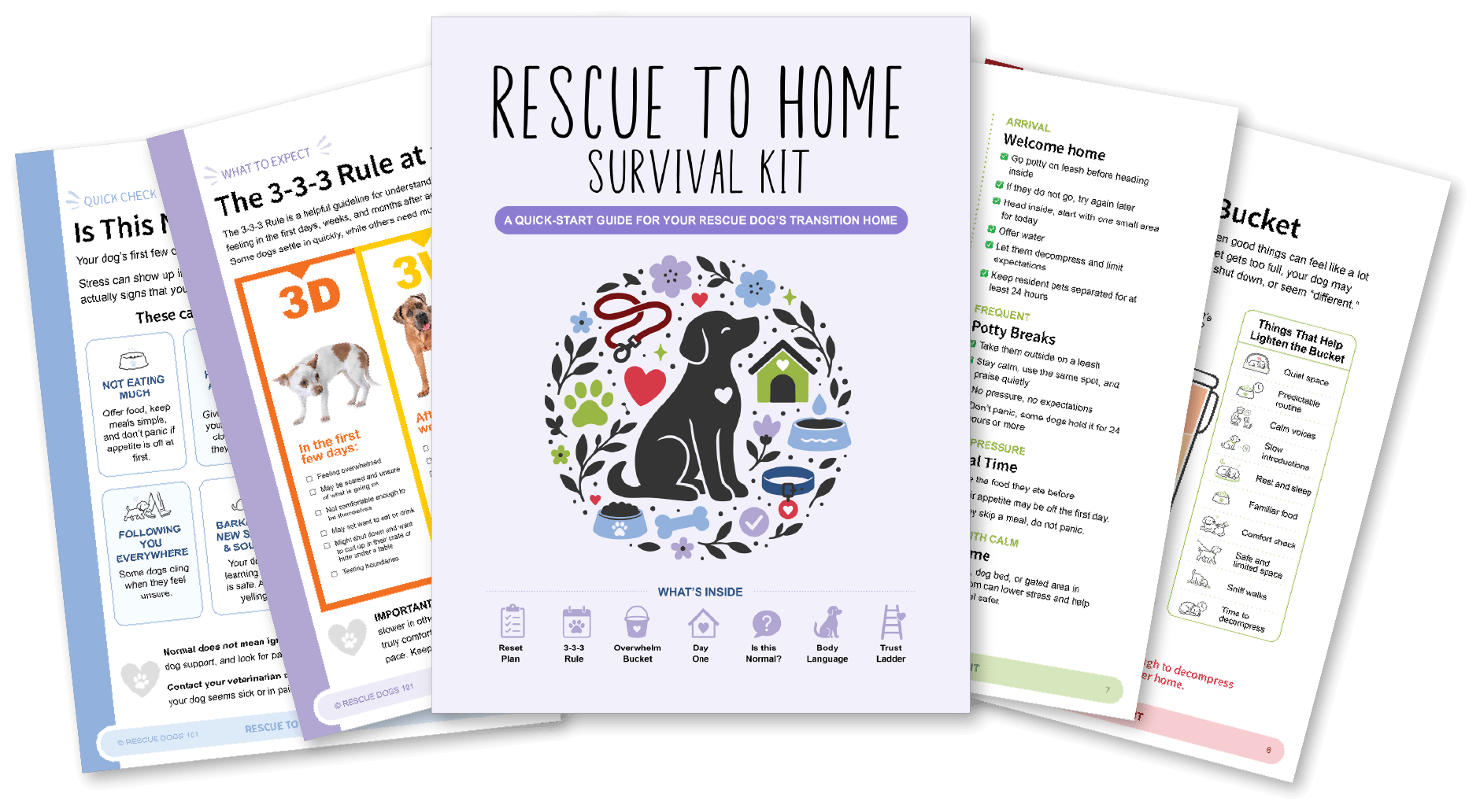
Download my free From Rescue to Home: Survival Kit for step-by-step help.
Or if you’re a rescue/shelter, grab the 3-3-3 graphics and adoption handbook templates for your organization.
What is the 3-3-3 Rule for Dogs?
The 3-3-3 rule is a general guideline that represents the phases of a rescue dog or common milestones your new dog will go through… it is the first 3 days, 3 weeks, and 3 months after bringing your dog home from the shelter.
The 3-3-3 rule is sometimes referred to as the “rescue dog honeymoon period.”
If you’ve ever started a new job or moved to a new school, you know the feeling of being in an unfamiliar place, new surroundings, new people, and new rules. This is how your dog feels as they adjust to their new home.

The 3 Stages of the 3-3-3 Rule
Please note that this is a guideline. The time your dog needs to adjust is as unique as they are.
Here’s what those first 3 days, 3 weeks, and 3 months look like in real life…

3 Days: Decompression
Your dog is likely overwhelmed, nervous, and unsure. Don’t expect too much right away. They might not eat or drink much and could be scared or unsure about their new environment.
Due to the stress, potty accidents may occur. During this time, they might hide or be very cautious around you and your family. Alternatively, they might test boundaries to see what they can get away with, similar to a teenager.
- Feeling overwhelmed
- Maybe scared and unsure of what is going on
- Not comfortable enough to be “themself”
- May not want to eat or drink
- Shut down and wants to curl up in his crate or hide under a table
- Testing the boundaries

3 Weeks: Learning the Routine
By now, your dog will typically start to settle in, feeling a little more comfortable and beginning to understand their new routine. They may start to show their true personality and begin to trust you more.
- Starting to settle in
- Feeling more comfortable
- Realizing this could possibly be their forever home
- Figured out their environment
- Getting into a routine
- Let their guard down and may start showing their true personality
- Behavior issues may start showing up

3 Months: Feeling at Home
This is when transformation shines. Your dog may start to trust you and feel secure in their new home. They may begin to settle into a routine and become comfortable with their environment.
This period is when you will see your dog’s true personality and begin to build a deeper bond.
- Finally, completely comfortable in his home.
- Building trust and a true bond
- Gained a complete sense of security with his new family
- Set in a routine
Adjusting to the Timeline
Remember, these timelines are general guidelines. Every dog is unique, and some may take longer to adjust. It’s important to be patient and not rush the process.
If your dog takes 6, 8, or even 12 months to fully adjust, that’s completely normal. The key is to provide a consistent, loving environment and celebrate the small victories along the way.
Your understanding and support during these phases are crucial in helping your rescue dog feel at home and begin to thrive.
Enjoy your newly adopted dog, give them love, support, and time, and they will soon become your best friend!
Common Mistakes Adopters Make
- Expecting their dog to be “normal” instantly.
- Flooding them with too many new people, places, or dogs.
- Initially, letting rules slide, then trying to enforce them later.
- Ignoring subtle stress signals (panting, pacing, avoidance).
Tips for Success
- Stick to the 3-3-3 timeline as a guideline, not a rigid rule. Every dog adjusts at their own pace.
- Focus on structure and bonding over tricks or obedience in the first weeks.
- Use enrichment games and confidence-building activities to help anxious dogs.
- Be patient. Progress isn’t always linear, but the payoff is huge.
Want a step-by-step plan for those first weeks and months? Download my free Rescue to Home Survival Kit… It’s packed with tips, checklists, and resources to help you and your new dog thrive together.
For Rescues & Shelters
I love that rescues and humane societies want to share the 3-3-3 Rule… it’s such a powerful tool to set adopters up for success. But instead of recreating the wheel (and risking incorrect info), you can get:
- The official 3-3-3 graphics for commercial use
- Or the complete Dog Adoption Handbook Template Pack, which includes the 3-3-3 Rule and so much more for your adopters
Click here to get the 3-3-3 Rule graphics and adoption templates.
How to Share This Graphic
Rescues & shelters: I love it when organizations use the 3-3-3 Rule to educate adopters. Please do not recreate or alter this graphic.
You are welcome to share it on your website or social media, provided you attribute the content and include a link back to this page.
If you’d like to use it in printed materials or adoption packets, please purchase the official 3-3-3 graphics for commercial use or the full Dog Adoption Handbook Template Pack.
Together, we can make sure every adopter understands what their new dog needs to succeed.

The Origin of the 3-3-3 Rule
The 3-3-3 Rule was originally created over 15 years ago by Sue Kroyer, a long-time rescuer who ran the Cocker Connection Rescue in Los Angeles. She shared it with discouraged adopters to give them a perspective on what to expect.
Years later, I (Debi McKee, Rescue Dogs 101) designed the now well-known 3-3-3 graphic and wrote one of the first comprehensive blog posts explaining the rule in detail. That visual made the 3-3-3 Rule easy to share… and it quickly spread across the internet.
So while Sue is the originator of the concept, I’m grateful to have helped bring it to life visually and make it accessible to adopters and rescues worldwide.
FAQs About the 3-3-3 Rule
How long will it take MY rescue dog to adjust?
The honest answer is, it depends. Some dogs will follow the 3-3-3 rule to the letter, while others may take 6 months or a full year to feel completely comfortable.
Keep in mind that the 3-3-3 dog rule is a general guideline. It will depend on the situation the dog was surrendered, the dog’s personality, and their background.
What can I do to help my rescue dog adjust faster?
Patience is key, but there are ways to support your dog. Keep routines predictable, offer a safe space, use calm and positive reinforcement, and avoid overwhelming them with too many new experiences at once. Small, consistent steps build trust faster than rushing things.
Should I follow the 3-3-3 Rule exactly?
The 3-3-3 Rule is a guideline, not a strict formula. Every dog is different. Some may breeze through in a matter of weeks, while others may need many months. Use the rule as a framework to set expectations, but always follow your dog’s pace.
What if my dog isn’t improving after 3 months?
Don’t panic… many rescue dogs take 6 months to a year to feel fully settled. If your dog still appears anxious, consider consulting a trainer or veterinarian to rule out any underlying medical issues. Progress may be slower, but with consistency and patience, most dogs come around.
Final Thoughts
I encourage you to take it slow. I know it’s exciting to get a new dog, but see life through your dog’s eyes…
They have been through a lot, they may have lost their family, possibly been abused, or abandoned in a noisy shelter, … it’s all very stressful. Your dog needs time, so give it to them.
Remember, the 3-3-3 dog rule is a general guideline. Your dog will go at their own pace during this “honeymoon period”; it could take 4, 5, or maybe even 6 months.
Each dog is unique. Just be there for them, comfort them when they need it, and create a positive, safe environment, and you will be on your way to raising your perfect dog.
Whether you’re an adopter or an organization, please share this message — but do it with proper credit and accurate information. That’s how we help more dogs find and stay in their forever homes.

Hi,
Thanks for the encouragement. I had heard the 3-3-3 before but thanks for the additional info. Our sweet Rico was rescued from Puerto Rico in October and transferred to a shelter in FL. He had some parasites so he was treated for those and available for adoption at the beginning of January. We adopted him then. He has been so sweet to our kids, my husband, and me. I don’t know what trauma he went through but he is sometimes very fearful. I took him to the vet today and he was so nervous. The staff there would extend a hand and give him a treat. Initially, he’s lick them and wag his tail but then he’d suddenly growl or even try to bite. It was very surprising. They highly encouraged me to find puppy training class for him and I will but it was all so discouraging. Any tips?
Hi Stephanie, congrats on your new puppy. You didn’t mention how old he is. I’m curious because if it is still a young puppy then the growl/bite would be more surprising to me. I recommend reading through some more of our resources. There are articles about fear that I think would help you. You’ve only had him for a few weeks, so be patient. I do think finding a good training program will be beneficial.
New rescue dog, 3 yrs old, poodle. He is very gentle and will sit in my lap.. I think he is depressed and would prefer to be alone. He loves walks but that is the only time he seems happy. He is now on couch,curled up and will not interact with me. We have just begun this journey and I want to do the right thing to help his depressed state any suggeztions
Heidi, it’s going to take time for your poodle to adjust. Be patient and give him the space he wants and needs. Not all dogs are cuddlers. Our dog Ginger, much prefers to be by herself, in fact she will seek her crate anytime she wants to be left alone.
I brought a pitbull home from our local shelter in Calgary Ab. It’s amazing to see the progress he has made even in a few days. He’s eager to learn the rules and to check in with me for reassurance he is doing the good thing. I can’t wait to see what the following days-weeks and months will be as he settles in and feels confident that he is in his forever home!
Congrats on your new adoption Sarah! So happy to hear everything is going well.
We have adopted a 6 year bishon/poodle mix, we have had him 2 weeks, he has adjusted so well, we have two other dogs, one is 13months and the other 9months.
All has been well, the puppy is a territorial.
Dexter the adopted dog has started growling and last night bit my husband. After the incident my husband picked him up and sat with him, To show who is in charge.
Today he has been fine.
We need advice, please we love him and have no idea what made him do this!! His bottom teeth is missing not sure why.
Grace, I recommend you seek a local balanced, behaviorist dog trainer to help you understand how to handle your new pup. Picking the dog up and sitting with him isn’t going to change his behavior. Learn his body language so you understand what he is telling you. The growling is usually not the first sign of a dog bite. Read through our blog, there are many resources to help you in your journey.
I brought home a 3 and a half year old rescue dog from Kuwait today. I dont know if it’s normal but she was happy and quiet the whole ride home. She seems to have made herself at home already. She bonded with my 16yr daughter right from the start. First night and already she’s sleeping on my daughter’s bed.
The only issue I have is that she likes to jump up on people when saying hi to them.
What’s the best way to train her not to do that??
Also, how do I train her not to pull on the leach when I take her outside??
This is all new to me seeing how I’ve only ever had cats
Thank you so much for any advice.
I adopted a 6 yo Yorkie/schnauzer mix about three months ago. He is truly a sweetheart and very smart. He is very quiet for a little dog which I appreciate!
I am very consistent with our schedule….and you are right, he knows exactly when mealtime is! I devote time just for him every evening for training and playtime. We are signed up for a good manner class this month, mostly for the socialization.
I think he is adjusting well. Best thing I could have done was adopting him! He just melts my heart! We are on our way to being best friends!
I adopted my dog from South Korea 8.5 months ago and it was definitely challenging. More so than most dogs as my dog came from a dog meat farm and had no true human interaction. Regardless though, he’s been thriving here since the first week we brought him home. But I do have to say, my dog is still not 100% where I’d like him to be as he is still becoming more comfortable with human contact and affection. He went through a regretion 3-4 months in. Didn’t like anyone coming in our house and oddly didn’t like other dogs. It was completely out of no where. He seemed to be a bit lost. But as the weeks passed, he changed and becamr more and more confident, happy and sure of himself. As of now, he’s really content and I know as the months go by, we’ll be cuddling on the couch in no time.
I have recently adopted a rescue 8 year old dauchund that was rescued from a puppy mill after she could no longer breed. She and I have really bonded, but she is so very protective of me nd our home that she barks, growls and carries on when my children and grandchildren come to visit. How can I get her to calm down and be pleasant to visitors. I really need you help as I don’t want to have to return her to the rescue group. I’ m certain she hasn’t had a great “dog’s life”, but I need to be able to be with family without her growling and barking, and I certainly don’t want anyone bitten.
Thank you.
HI
We jus really brought home a week ago a rescued 8 month old lab . SHe is very sweet and behaved when she is calm . But when she gets the puppy crazies ( who’s is a few times a day) she does not listen to me at all. She play bites too hard and sometimes does not release. SHE also constantly tried to play tug of war with her leash . We have her signed up for classes but they don’t start until December 7th. Help !!
It sounds like she needs more physical and mental exercise. Labs are great dogs, in fact my favorite breed. But the misconception is that they are laid back, easy dogs… which they can be as long as you provide them with the exercise they need. Take long walks, play fetch, and try puzzle games. If you come home from a walk and she still gets the “crazies”, then take a longer walk.
Hi, we adopted a 6 year old pomaranion. She was delivered to us in a crate. She so wants outside but will not allow touch so we can’t put a lead on and definitely no harness. Is it just a matter of trust and time.
Without knowing the entire situation the dog has been in before coming to you, I can’t say for sure, but yes trust and time are a big factor. And it’s not going to be easy. It will most likely take weeks, months, maybe even more in severe situations.