
The 3-3-3 Rule helps adopters understand the timeline for a rescue dog’s adjustment: 3 days to decompress, 3 weeks to learn routines, and 3 months to feel fully at home.
This guide explains each stage, shares real-life stories, and offers tips to help you avoid common mistakes.
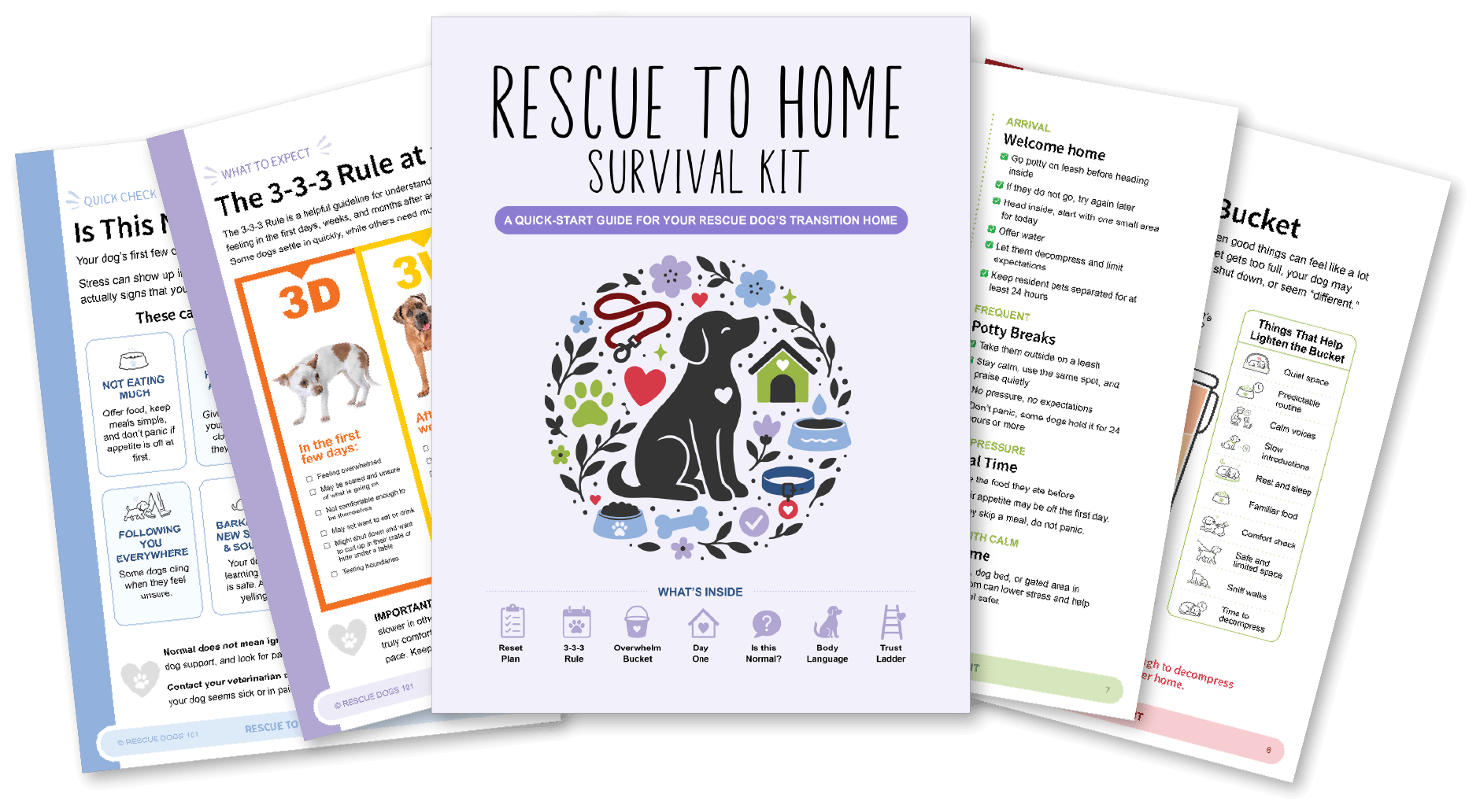
Download my free From Rescue to Home: Survival Kit for step-by-step help.
Or if you’re a rescue/shelter, grab the 3-3-3 graphics and adoption handbook templates for your organization.
What is the 3-3-3 Rule for Dogs?
The 3-3-3 rule is a general guideline that represents the phases of a rescue dog or common milestones your new dog will go through… it is the first 3 days, 3 weeks, and 3 months after bringing your dog home from the shelter.
The 3-3-3 rule is sometimes referred to as the “rescue dog honeymoon period.”
If you’ve ever started a new job or moved to a new school, you know the feeling of being in an unfamiliar place, new surroundings, new people, and new rules. This is how your dog feels as they adjust to their new home.

The 3 Stages of the 3-3-3 Rule
Please note that this is a guideline. The time your dog needs to adjust is as unique as they are.
Here’s what those first 3 days, 3 weeks, and 3 months look like in real life…

3 Days: Decompression
Your dog is likely overwhelmed, nervous, and unsure. Don’t expect too much right away. They might not eat or drink much and could be scared or unsure about their new environment.
Due to the stress, potty accidents may occur. During this time, they might hide or be very cautious around you and your family. Alternatively, they might test boundaries to see what they can get away with, similar to a teenager.
- Feeling overwhelmed
- Maybe scared and unsure of what is going on
- Not comfortable enough to be “themself”
- May not want to eat or drink
- Shut down and wants to curl up in his crate or hide under a table
- Testing the boundaries

3 Weeks: Learning the Routine
By now, your dog will typically start to settle in, feeling a little more comfortable and beginning to understand their new routine. They may start to show their true personality and begin to trust you more.
- Starting to settle in
- Feeling more comfortable
- Realizing this could possibly be their forever home
- Figured out their environment
- Getting into a routine
- Let their guard down and may start showing their true personality
- Behavior issues may start showing up

3 Months: Feeling at Home
This is when transformation shines. Your dog may start to trust you and feel secure in their new home. They may begin to settle into a routine and become comfortable with their environment.
This period is when you will see your dog’s true personality and begin to build a deeper bond.
- Finally, completely comfortable in his home.
- Building trust and a true bond
- Gained a complete sense of security with his new family
- Set in a routine
Adjusting to the Timeline
Remember, these timelines are general guidelines. Every dog is unique, and some may take longer to adjust. It’s important to be patient and not rush the process.
If your dog takes 6, 8, or even 12 months to fully adjust, that’s completely normal. The key is to provide a consistent, loving environment and celebrate the small victories along the way.
Your understanding and support during these phases are crucial in helping your rescue dog feel at home and begin to thrive.
Enjoy your newly adopted dog, give them love, support, and time, and they will soon become your best friend!
Common Mistakes Adopters Make
- Expecting their dog to be “normal” instantly.
- Flooding them with too many new people, places, or dogs.
- Initially, letting rules slide, then trying to enforce them later.
- Ignoring subtle stress signals (panting, pacing, avoidance).
Tips for Success
- Stick to the 3-3-3 timeline as a guideline, not a rigid rule. Every dog adjusts at their own pace.
- Focus on structure and bonding over tricks or obedience in the first weeks.
- Use enrichment games and confidence-building activities to help anxious dogs.
- Be patient. Progress isn’t always linear, but the payoff is huge.
Want a step-by-step plan for those first weeks and months? Download my free Rescue to Home Survival Kit… It’s packed with tips, checklists, and resources to help you and your new dog thrive together.
For Rescues & Shelters
I love that rescues and humane societies want to share the 3-3-3 Rule… it’s such a powerful tool to set adopters up for success. But instead of recreating the wheel (and risking incorrect info), you can get:
- The official 3-3-3 graphics for commercial use
- Or the complete Dog Adoption Handbook Template Pack, which includes the 3-3-3 Rule and so much more for your adopters
Click here to get the 3-3-3 Rule graphics and adoption templates.
How to Share This Graphic
Rescues & shelters: I love it when organizations use the 3-3-3 Rule to educate adopters. Please do not recreate or alter this graphic.
You are welcome to share it on your website or social media, provided you attribute the content and include a link back to this page.
If you’d like to use it in printed materials or adoption packets, please purchase the official 3-3-3 graphics for commercial use or the full Dog Adoption Handbook Template Pack.
Together, we can make sure every adopter understands what their new dog needs to succeed.

The Origin of the 3-3-3 Rule
The 3-3-3 Rule was originally created over 15 years ago by Sue Kroyer, a long-time rescuer who ran the Cocker Connection Rescue in Los Angeles. She shared it with discouraged adopters to give them a perspective on what to expect.
Years later, I (Debi McKee, Rescue Dogs 101) designed the now well-known 3-3-3 graphic and wrote one of the first comprehensive blog posts explaining the rule in detail. That visual made the 3-3-3 Rule easy to share… and it quickly spread across the internet.
So while Sue is the originator of the concept, I’m grateful to have helped bring it to life visually and make it accessible to adopters and rescues worldwide.
FAQs About the 3-3-3 Rule
How long will it take MY rescue dog to adjust?
The honest answer is, it depends. Some dogs will follow the 3-3-3 rule to the letter, while others may take 6 months or a full year to feel completely comfortable.
Keep in mind that the 3-3-3 dog rule is a general guideline. It will depend on the situation the dog was surrendered, the dog’s personality, and their background.
What can I do to help my rescue dog adjust faster?
Patience is key, but there are ways to support your dog. Keep routines predictable, offer a safe space, use calm and positive reinforcement, and avoid overwhelming them with too many new experiences at once. Small, consistent steps build trust faster than rushing things.
Should I follow the 3-3-3 Rule exactly?
The 3-3-3 Rule is a guideline, not a strict formula. Every dog is different. Some may breeze through in a matter of weeks, while others may need many months. Use the rule as a framework to set expectations, but always follow your dog’s pace.
What if my dog isn’t improving after 3 months?
Don’t panic… many rescue dogs take 6 months to a year to feel fully settled. If your dog still appears anxious, consider consulting a trainer or veterinarian to rule out any underlying medical issues. Progress may be slower, but with consistency and patience, most dogs come around.
Final Thoughts
I encourage you to take it slow. I know it’s exciting to get a new dog, but see life through your dog’s eyes…
They have been through a lot, they may have lost their family, possibly been abused, or abandoned in a noisy shelter, … it’s all very stressful. Your dog needs time, so give it to them.
Remember, the 3-3-3 dog rule is a general guideline. Your dog will go at their own pace during this “honeymoon period”; it could take 4, 5, or maybe even 6 months.
Each dog is unique. Just be there for them, comfort them when they need it, and create a positive, safe environment, and you will be on your way to raising your perfect dog.
Whether you’re an adopter or an organization, please share this message — but do it with proper credit and accurate information. That’s how we help more dogs find and stay in their forever homes.

Your website is so informative and has put my mind at rest. I foster dogs and for the first time EVER I have such a nervous timid dog, who won’t go out and pee which really concerns me. But having read your advice and replies to other peoples’ concerns, I’m just going to give it time and not worry too much about not peeing. It’s only been a couple of days, so fingers crossed it will all come good. Thnk you Debi.
You are so welcome! Make sure to join our Facebook group too… it’s a great support system for everyone. https://www.facebook.com/groups/rescuedogs101community
Me my mum and dad recently adopted 2 rescue dogs. Both female, both very very scared. Ones better than the other and loves to play and bounce around but the other is so shy and wees quite a lot in the house because of how scared she is all the time. She wants to be on her own doing her own thing she doesn’t want to be with anyone else. They’re both rescued dogs from the streets of Greece and both don’t like men. They aren’t bonding with my dad and we’re really struggling to get them bonding properly, to the point where we’re looking at sending them back to their shelter. We really don’t want to send them back, but we can’t think of any other option. It’s been 8 weeks now and not much has improved, please help 🙁
These dogs had no home life before adopting them. They need a lot of time to learn and adjust. 8 weeks seems like forever for you, but for them it’s still all so new. Even for a well adjusted dog that has lived in a home previously, it could take upward of 3 months. Your dogs have not had any benefit of living with people in a home until now. It could take many more months, maybe even a year. It all depends on the dog. I understand the frustration but if you can hang in there I’m sure you will slowly see improvements. Maybe if your family could hire a behaviorist trainer they could help you.
This was helpful. We just rescued an 8 month old puppy lab mix.
I rescued a shihtzu x about a month and a half ago.She started off scared, than went to loving, now she’s acting aggressive. Is this normal?
Describe acting aggressive. Aggressive toward people or other dogs? It’s likely she growling out of fear. I’d find a good behaviorist trainer to help you.
Hi, It was so lovely to read your website. I have rescued 9 dogs over the years. I have now adopted a 17 month old German Shepherd X from Dogs Trust 6 days ago. She is so nervous and needs training which I was aware of , but over the years I have had dogs I never had a dog that has had diarrhoea since the day he/she came in my home. Have had some Pro kolin from the vets but she is still very runny at times. She is settling in well and I am aware with fireworks this could also not help. Dont want to go to vets again unless I have to but was thinking of giving her Chappie with her dry food instead of boiled chicken and rice. She is loving and comes when I call her. Any information would be most appreciated. Thankyou. Suzanne
It’s pretty common for dogs to have upset belly’s for the first week or so after adoption. They are stressed and so it’s understandable. Give her time, make sure she’s getting enough water and doesn’t become dehydrated. Try adding pumpkin, read https://www.rescuedogs101.com/ultimate-guide-can-dog-eat-pumpkin/
I am fostering to adopt a dog from a shelter….she is excellently trained and sweet….but she appears extremely depressed and cries non stop to go outside and cries outside sniffing the air and looking around…she has no interest in toys, bones, play etc…I have had her for about a month and she was in a shelter for about 6-7 weeks… it is difficult to bond as she appears indifferent and only seems to want to get outside to sniff the air and look around…she cries to go outside but only potties on about her 4th time outside..otherwise she just sniffs the air and cries…
Help!
So sorry Marie, it’s tough to see them struggle. I suggest joining our private facebook group, it’s a great support system. https://www.facebook.com/groups/rescuedogs101community/
Thanks for this, I’m glad to know that it is “normal” for our new rescue dog (9 month old border collie) to be mostly just sleeping and not wanting to go out for walks! This surprised us because I expected a border collie to need and want lots of exercise. The main thing now is that our young child (7yo) is very active and loud, and this keeps scaring the dog even when the noise and activity is not near him, but very dramatically when it is. Will the dog grow out of this, or is this a situation where it is not a good fit? How will we know and when? (We are on day 4 now so pretty early.) Also, the dog is not showing any interest in treats, so our training efforts are stymied. Any advice? Thank you!
My biggest advice is TIME. Border collies are very sensitive to their environment and people. Try to give her a quiet space away from the action of the house. All her to come out as she feels comfortable. As for treats, totally normal for the first few days/weeks. If she turns out to not be food motivated, then try toys and affection… but not yet. Wait and give her time to decompress.
We adopted our Black and Tan coonhound 9 days ago. He came to us as quite the jumper! Within 48 hours with lots of praise and treats he learned to sit and to wait and stopped jumping on us and our counters/tables. On his 3rd night he barked and snapped at me when I went to close his crate door for the night. He did the same thing the next night when my husband touched the blanket he was sleeping on outside of the crate. We read up on crate/bed guarding and aggression and worked on treating him through the crate. We also replaced his blanket (blanket was new to our home, he didn’t come with it) with just a cushy mat. Now it seems like I have a situation where 95% of the time he is perfectly happy to let us around his crate but I cannot predict when he will jump and snap if he is approached in his crate. Since he also did this one time out of the crate, I can’t say if this is a crate, blanket, or sleeping issue. I really want this adoption to work but I am losing trust in him, not gaining. I am heartbroken because we love him already but I worry he might bite if startled or disturbed just one time in just the wrong way. Any suggestions?
I sympathize with you, I really do. 9 days is very early on in the transition period, so I would normally suggest giving him more time. But on the other hand I can totally understand your feelings. Read Our Heartbreaking, Gut Wrenching Adoption Story. I am sure with time and training the dog can become a well adjusted family member. It just depends on whether you want or have the ability to give him what he needs. Also read Is it Ever Okay to Rehome a Dog?. Only you can make the decision, do what is best for you and the dog.
Hey! Just checking in to see how your doggie us doing. We just adopted a Treeing Walker Coonhound on September 26th, 2020 and she is just beginning to settle in. She’s extremely active though!! I hope yours is doing better!
We have had our rescue dog since Nov. Not friendly towards other dogs and takes out things and chews them up for attention
Can we start over and do what s called the 2 week shut down?
You’ve had the dog for 10 months now. Starting over may not be the right phrase. But you can start to implement strategies to help your pup. If he is chewing for attention, that means he is not getting enough physical and mental exercise. Take him for walks every day, do simple training sessions, play games, etc. There are many resources on the blog. As for not being friendly with other dogs, that could be a result of his boredom or a variety of other issues. I’d recommend seeking out a dog behavior trainer for help.
Our 1 year old newly adopted dog sleeps constantly. When I try to take her out to potty, she resists going out the door, tries to get back in, and the just lays down in the grass and won’t get up. Some time before we got her; she’s been punished for going indoors and doesn’t want to go at all when people are near.